Showing posts with label language. Show all posts

3.18.2012

On reading and the joys of patient storytelling -- An incomplete essay


I’ve got a case of textual compulsion, I’ll tell them when they inevitably come to cart me away. I only wish I had the words when I was younger, when I would get lost in the words of others – not because my intention was to ignore my family or friends, but because the pages bound together inside the various hard and soft covers strewn haphazardly about the floor, on the shelves, and in the closet of my childhood bedroom bore keys to secret places and magical worlds where the improbable was the norm, where the norm seemed unimaginable, and where an author’s quotidian noticings of a piece of paper, pane of glass, or sounds of water splashing from an afternoon swim infused my adolescent melancholy with near-idiotic giddiness. It would be incomplete to say that I defined myself through my reading, although that statement, however trite, was true. No, it was more than that, more than stories and word paintings as a mere escape from reality or as the original Second Life. Rick Moody’s definition of textual compulsion comes close:

“it’s a joyful and exciting thing when you’re in the midst of it, textual compulsion.
true textual compulsion is that there has to be that element of sacrifice. Are you foregoing food and social relations? Are your personal relationships suffering? Are you going to read these books more or less sequentially?”

From my earliest memories, as a child and into adolescence, reading was an act through which I embraced the words and their creator (or perhaps their curator); the author was never far from my thoughts: where did she sit or stand or lounge when this image came into her mind? Was the story waiting for him or did he find his way into it? Who does this character remind her of? Was Kansas or the 7th century or a pair of green shoes or a windy day particularly important to him? Did she experience a moment like the one that Berger describes when a scattering transforms into a meaning-full constellation: “At a certain moment -- if you're lucky -- the accumulation becomes an image -- that's to say it stops being a heap of signs and becomes a presence.”

I was seven or eight years old the first time I selected a book for myself beyond the bins of books in the classroom. We – that is, my fellow classmates and I – had been escorted to the library by our teacher. (And if I am remembering correctly, this is our second grade teacher whose hair was never anything but extravagantly voluminous.) While most had chosen a book and were either sitting and reading or talking quietly with each other, I had wandered over to an unfamiliar section where the bookcases were higher – six shelves instead of three. This memory, true or not, is held in my mind’s eye much like a rubbing made from a stone carving or sculpture – textured, tactile, a once removed representation of the thing, a new thing itself. This differs from another reading memory in which I am performing my first solo read aloud of “Three Billy Goats Gruff” a couple of years earlier for my uncle who was visiting from London; this is my parents’ story, my uncle’s story, my grandmother’s story and has become a part of my mental memory box as part recall and part verbal reconstruction of the retellings of others. Charlotte Linde, during a talk she gave at Teachers College a few years ago, said of this very notion that “Our story exists in the memories and narratives of others.” And they in ours.

But that afternoon or morning in the library, Carolyn Keene felt like my own discovery and the adventures of Nancy, Bess, and George were mine to explore, free from the expectations of others. I have a constructed memory of the forest green, linen book cover with fraying, slightly yellowed corners and pages that were not pristine – evidence that more than a few someones before me had thumbed through them. Holding the book, I remember turning it around in my hands, already convinced that it would be my check out for the day, and opening to the back – not to the end of the story, an action I regard as wholly unholy within the covenant between writers and their readers, but to the inside back cover where a small, manila colored pocket had been affixed, inside of which was a white, lined card onto which names and dates had been written and crossed out with some ceremony. It’s one of the things I miss in this era of digital downloading (a club to which I happily belong). No longer are we privy to the glimpses of the lives a book was enmeshed in for a while before coming into our temporary guardianship. And it is perhaps why visiting used bookstores sparks in me a familiar sense of possibility of what might be found inside, on the shelves and table, inside the pages, tucked into book jackets. (We may never really know the secret lives of books.)

The relationship is an intimate one, between reader and writer. Amelie Rorty assumes as much in her essay “The ethics of reading” when she implores us, as readers, to consider the author’s house – a magnificent image as ever there was one for visualizing the structural integrity of words and their foundations into and out of which stories are written – in how we read a text. We are meant to investigate a text, not merely to “get the information” but also to consider how it is and was located in the life of the author, and to conceive of the author, therefore, as situated in the world. Answers to the many questions that Rorty invites us to consider in her essay are not meant to be definitive; hers is not advocacy for navigating “text complexity” – rather, we are meant, as readers, to render visible  to fall into as it were – the beauteous complexity of texts. Can there be anything more revealing than the words of others? The ones that find their way to the final publication draft no doubt had countless antecedents. And to find wordsmithing that evokes joy, wonderment, and a desire to reread even before the initial read is complete – how can such discoveries lead to anything but textual compulsion?

In his essay, from which I quote above, Moody was referring directly to the work of W.G. Sebald. Since first reading a few pages of The Emigrants online, at the suggestion of a colleague, I have been transfixed by Sebald’s writing. I can’t yet say with any degree of eloquence or articulation exactly why this author’s words stay with me long after I read them, and now I cannot separate the reading of his words from the extensive readings of the man; the story of his stories invite this reader in more fully, with a wide embrace. In the film “Patience (After Sebald)” by filmmaker Grant Gee, more of these authorial layers are lifted ever so slightly to allow glimpses of the author’s multiple and varied situatedness. Gee intentionally stacked his interviews with artists and in so doing created a filmic narrative that foregrounds Sebald’s artistic craft. (A favorite image is one that a colleague of Sebald’s constructs as he recalls the author’s practice of taking photographs with highly precise lenses, taking them to be developed at the local pharmacy, Boots, and then copying them again and again, sometimes literally taking an eraser to the copies in order to create just the right amount of blurring; with both images and words, Sebald artfully obfuscated even as he explicated, offered rich description in order to unsettle a reader’s complacency.)

And it was Sebald who led me to “Open City,” a book by Teju Cole that has come to be so much more than a title on my “already read” list. I have reread this book in its entirety and again in parts several times over since first learning of it through pure serendipity: a search for something Sebaldian, while I was participating in my colleague’s summer seminar in which we pored over and read closely several of Sebald’s works, yielded a list of reviews of the then-recently published Open City. What first caught my eye were the consistent comparisons made about Cole to Sebald. Having had an intense introduction to the latter, I was compelled to read the former. That simple decision, to read a book, brought me into an already-happening dialogue that the book's narrator, Julius, was having with the imagined reader (or perhaps with himself). Reading Cole, like Sebald, was a welcoming experience -- even as they offer new intellectual tributaries to follow, their prose also pulses with tropes that, while seemingly familiar, resonate precisely because they are largely unexplored. Reading their words was very much like discovering a secret that begged, at once, to be closely guarded and also to be shared with the world. As a reader, I had a full sense of belonging. I daresay in their words – words that journeyed far to bring the world nearer  I found a home. learned quickly, however, that it was I who was on a journey that was far from being over; whatever this was, it had barely begun. Textual compulsion was reincarnated in this moment and led to an experience of heightened awareness about myself as a reader; the lives of those who storied with grace, with measure, and with nuance beckoned through their words. And each of these authors is careful with his words. That’s not to say that their writing is guarded or distant – in fact, quite the opposite is true. The narrative in Sebald’s The EmigrantsAusterlitz, and Rings of Saturn and Cole’s Open City is unhurried, attentive, embodying what Cole himself has described as a “breathable” quality. In these texts are orchestrations of words about the lives and worlds of selves and others that reflect a deep listening to the intermingling of souls. 

A kinship relationship emerges in the work of these writers that is bound by patient storytelling and Cole and Sebald are forever linked in my mind as one led me to the other, and then back again. And so it has continued this past year as their literary conversation – as Julius talks with Max Ferber, as Austerlitz makes meaning of Cole’s small fates – plays as a nonstop reel in the backdrop of my mind while I have found my way to Kiran Desai and Muriel Barberry and Iris Murdoch and Elizabeth Bowen. Sebald’s Campo Santo moved me to read Nabakov’s Speak, Memory, and Cole’s essays – among them, his views on Aciman’s Essay on Elsewhere and more recently on Ondaatje – have furthered my journey down, up, through, and around the proverbial, even Rilke-esque, rabbit hole. And in each instance, with every textual encounter, despite what may seem like an underlying narrative of reading voraciousness, these literary perambulations have remained, as the content may suggest, unhurried and unfolding. Patience in storytelling gently demands the same of readers. (Can we allow ourselves to be patient readers?)

How, then, do some words and prose become the ones we carry with us, in ways that they become part of our waking hours and penetrate our dreams? I’m not sure entirely, but the following passage from Jens Brockmeier’s essay on memory and Sebald’s Austerlitz suggests a place to start that inquiry. 

"No doubt, Austerlitz demands a serious reader who follows attentively a meandering syntax without clear paragraph structure, a peculiar mixture of the narrative voices of the protagonist and the narrator, several layers of free indirect thought and discourse, and wide-ranging associative chains that encompass extensive accounts of very specific details that may or may not contribute to a labyrinthine plot, if we can call it a plot at all. But my sense is that this book is puzzling not only because of its demanding narrative composition but also, more importantly, because it offers, in an unusual, perhaps unique way, a new view of memory and the autobiographical process."


10.24.2011

small fate of "illiteracy" looms large


The word “illiteracy” gives me pause.
No, that’s not quite right.

When I hear or read the word “illiteracy” I stop cold.
Closer.

The word “illiteracy” inflicts in me a sensation of violent nausea wherein my brow remains furrowed for several minutes and I incur the wrath of the involuntary teeth-mashing that starts in the face of acts of egregious inhumanity. It is a wonder that reading words about others’ horrid behaviors can induce this reaction, even more so, in my experience, than other modes of expression. See for instance these recent tweets by Teju Cole, author of Open City and a book review recently published in the New York Times about Andre Aciman’s new book, Alibis: Essays on Elsewhere.  [An aside before you delve into the small fates that Cole composes on Twitter: it is difficult to accept the recent claims by Noam Chomsky about the “shallow” nature of this medium after reading tweets written by a writer whose words, about the worlds he sees and discovers as well as those he brings together to let readers into the worlds of many others – including that of Aciman’s and the citizens of Lagos – with respect, irony, and a haunting beauty that moves his readers to write back, to interact, to engage, and to wonder aloud.]

Nsofor, 57, head of the vigilantes in Nwangele, entered a girl of four.

In Justice Yahaya's courtroom in Kano, Hamza got 24 months for child rape, and Sani got 30 for marijuana possession.

Déjà vu. At Mediterranean Park in Abuja, words failed Sunday Nzeh, so he stuck a pen in Sarah Odere’s eye.

If it’s not one thing, it’s your mother. With petrol and matches, Akinkuotu, of Ondo, orphaned himself.

In 140 characters or less, Cole’s distillations of news from Lagos newspapers deliver a punch (to the gut, to the psyche, to the soul), even more potent, perhaps, than the fuller length accounts of the always human and often inhumane acts he chooses to remix. His are words about actions that may go unheard or overlooked, in part simply by virtue of their geographical distance from our daily lives and partially because of the metaphorical and metaphysical walls we build in our attempts to hyper-focus on our immediate and proximal realities. In giving those realities of distanced others a wider and varied audience, Cole brings their happenings, both familiar and strange, through our phones and laptops into our conscious minds; often these remixes, that serve as poignant social commentary on that which might otherwise be accepted as “normal” behaviors and acceptable social practices, demand our attention precisely because of their abhorrence.

But while such visceral reactions, such as the one described above, may be understandable in light of the small fates about which Cole writes, one might wonder why and how the concept of “illiteracy” evokes the same. For context, I turn to a recently published column in the local news website, Philly.com, written by Inquirer columnist Karen Heller titled, “Illiteracy,the scourge of Philadelphia.” In it she correlates “illiteracy” with poverty – and in so doing, borders on accusations of causation – and proceeds to accomplish what she likely set out to do: disrupt social malaise long enough to evoke discomfiture in readers who may otherwise place themselves at a far remove from the realities she asserts.  Presumably, the logic might go, if we taught more kids to decode print in a timely fashion, socioeconomic disparity would be grossly alleviated, if not eliminated altogether. This is not an indictment of Heller; she is writing in the socially acceptable language of literacy that, despite more than ample evidence to the contrary, remains squarely framed as “reading at an eighth-grade level and possessing basic math and computer skills, abilities that more than half a million residents are missing.”  We – that is, researchers, educators, writers in and of multiple media – still have far to go, it seems, before we are able to effectively disrupt the social imaginary on matters related to literacy and language practices.

The distaste, the sheer disdain I have for the word “illiteracy” lies in assumptions that the word carries about all who are unfortunate enough to be viewed through its veil. Although Heller relies on quotes from Judith Rényi and Lisa Schorr, both of whom have been appointed to educational roles within the administration of the city of Philadelphia, her column underscores the wide reach of the topic of literacy as it becomes ensnared with other social ills such as unemployment and incarceration. Heller writes:
"Uncorrected, a lack of literacy remains a lifelong disability. "A person walking around illiterate at 35 is going to be illiterate 50 years from now," Rényi says. That 50 years translates into low-level or no employment, an ongoing dependence on social services, or worse. Most of Philadelphia's prison population reads below the fourth-grade level, demonstrating few resources for legal employment."
Her column, like the writing of other columnists and journalists who will continue to, as they have in the past, inform the collective mind of the populous, carries weight. Perhaps one column of 500 words may not change anything, but a few hundred words here, an evening news story there, a blog post that captures the attention of a political machine eager for an educational soundbyte – an especially dangerous possibility as we enter the next presidential election cycle – and suddenly we may find ourselves on the precipice of another No Child Left Behind. Teachers' hands and tongues become tied when, as a nation, we are prone to follow and vote for a catchy slogan over what may be jarring prose. Words matter.

Children and adults walk into classrooms prepared to learn and too often they are castigated for what they lack; so all-consuming must be this practice of judgment and evaluation that it is a wonder any learning happens at all in schools and other institutions of purported learning. In seeking to teach, educators are steered away from the education already thriving in the lives of their students. If we change nothing else – that is, if we continue to strive for print proficiency in children and all adults, adhere to common content and communicative standards, while navigating the tricky waters of an increasingly inexplicable testing culture (clearly hell-bent on ensuring its own existence above all else) – but remove “illiteracy” from our vocabularies of categorization, then we will have made a significant change. To view someone as “illiterate” is not merely a neutral or socio-demographic designation. It is an act of dehumanization. 

Words matter. The word “illiteracy” matters. And insofar as “illiteracy” will continue to inflict educational and psychic damage – and keep the proverbial wheels squarely situated in slippery mud – a simple shift toward literacies can provide openings for understanding the literate lives and the meaning-full existences of students, older and newer, toward new starting points that are more likely to yield "outcomes" that the warriors against "illiteracy" claim to desire.

Perhaps this is better expressed as a small fate:

Angel told stories to anyone who listened. His teachers insisted they couldn’t teach him or hear his words unless they were written down.

9.19.2011

for the love of picture books

it is perhaps fitting that my return to this blog, after a brief hiatus, comes following a memorial service for larry sipe, a former professor and the person who gave me words with which to describe my own love of books and stories and characters and narrative delights: jouissance! plaisir! performative responses! cover pages! aesthetic!

among my favorites that larry introduced me to, that i have been thinking about and revisiting in the several months since his passing are:
The Stinky Cheese Man and Other Fairly Stupid Tales


The Giver

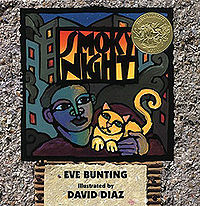
Smoky Night

and if you want to hear more about children's and young adult literature, definitely check out the very excellent blog: The Classroom Bookshelf: Teaching with Children's and Young Adult Literature in the 21st Century.

over the next several months, i'll be sharing reflections on the many ways i continue to witness the joy for stories that larry held and shared as they thrive in the practices of the many young people i've spent time with these last several years. in part, this will be a part of the collection of essays i am preparing along with my research team in a book about bringing an arts-based approach to digital media in literacy explorations with youth, particularly court-involved youth. and other vignettes will be drawn from a book length manuscript i'm working on based on five years of ethnographic research at the program i've called ATIP in various publications.

for now, though, i'll take in the jouissance that comes with recognizing the beauty of a beautifully crafted page, made of pastels and paint and cutouts and hours of labor...

9.18.2011

my "letteracies" -- installment 4

over the past several months, i had forgotten to post this last installment. as i read through it now i am struck only by one lasting thought: how precious words can be as a marker of a moment in time. and perhaps bound up in this observation is also the significance of audience, of someone or a few someones who permeate our minds as we compose a text, who infuse our compositions with a small smile or a belly laugh, whose presence pushes us to write to completion, who give our writing purpose and urgency. this is, then, a blanket thank you for the audiences i have had the pleasure of writing to and with and hope to continue a dialogue with in the months and years to come...

and so, without further mediation, the last installment:


8.21.93

Getting back to the Taj Mahal: it was beautiful. That’s it. As much as I always wanted to see it, I never really wanted to go in – or go very close for that matter. I don’t know why exactly. Perhaps because actually going in would cause the Taj to lose some of its mystique and enigmatic charm… and it did. Thinking back now it seems almost unreal that I was there. In fact this whole month has just been, what seems like, a big blur. But, all that’s not to say that this isn’t a truly magnificent piece of architecture. Actually it’s more than that. it’s a symbol of the magnitude of Shah Jahan’s love for his wife. And, well, that right there is nothing short of absolutely beautiful. It’s even better because such a symbol exists in a country where, traditionally, love isn’t as widely shown or publicized.

People often say patience is a virtue. This couldn’t be truer. But just as there is virtue in being patient, there is virtue in being content, hence contentment, too, is a virtue. The lack of this can be a deadly thing. This of course doesn’t mean that you shouldn’t strive to better yourself knowledge-wise, spiritually, and internally, for there is always room for improvement and learning. I just mean that always wanting what other people have or never being satisfied unless on has as much of more than others is not healthy at all and can be damaging to both the person who thinks this way and the recipient of such behavior.

I hate jealousy. I hate manipulation. I hate arrogance. I hate people taking advantage of others. I hate lying. I hate cheating. I hate meanness. I hate fakes. I hate corruption. I hate prejudice. I hate superficiality. I hate people who aren’t what they portray themselves to be. I hate hypocrites. I hate myself for not seeing people for what/who they really are in the first place. I hate jealousy.

8.24.93
As I’m writing now I’m sitting on my bed at home, in my room, with my back against the “unfinished wall,” listening to the jazz station, hearing a fly have repeated encounters with different objects in the room. It’s good to be home and, as usual, it’s hell to be home.
I saw my friends last night. It felt good to laugh like that again.
Did you ever have so many thoughts to write down that you couldn’t do it because there were just too many and they were all just fragmented thoughts anyway? Well, that’s what’s happening to now, and has been for quite a while. It’s fun just thinking them though.
Well, I’m sure that this proved to be an interesting, and probably tedious, piece of writing to read and if you got this far you definitely deserve a 3 Musketeers bar. I’ll end this “saga” just by wishing you a good year and thanking you for just … being you :)

10.21.2009

new book on comparative education


if you're interested in international perspectives on educational policy and practice, then this is the book for you:

Critical Approaches to Comparative Education: Vertical Case Studies from Africa, Europe, the Middle East, and the Americas
Edited by: Frances Vavrus and Lesley Bartlett

Description:
This book unites a dynamic group of scholars who examine linkages among local, national, and international levels of educational policy and practice. Utilizing multi-sited, ethnographic approaches, the essays explore vertical interactions across diverse levels of policy and practice while prompting horizontal comparisons across twelve sites in Africa, Europe, the Middle East, and the Americas. The vertical case studies focus on a range of topics, including participatory development, the politics of culture and language, neoliberal educational reforms, and education in post-conflict settings. Editors Vavrus and Bartlett contribute to comparative theory and practice by demonstrating the advantages of ‘thinking vertically.’

Table of Contents:
PART I: APPROPRIATING EDUCATIONAL POLICIES AND PROGRAMS * Localizing No Child Left Behind:  Supplemental Educational Services (SES) in New York City * The Décalage and Bricolage of Higher Education Policymaking in an Inter/national System:  The Unintended Consequences of Participation in the 1992 Senegalese CNES Reform * AIDS and Edutainment:  Inter/National Health Education in Tanzanian Secondary Schools * PART II: EXPLORING PARTICIPATION IN INTER/NATIONAL DEVELOPMENT DISCOURSE * Questioning Participation:  Exploring Discourses and Practices of Community Participation in Education Reform in Tanzania * Living Participation: Considering the Promise and Politics of Participatory Educational Reforms in Brazil * Transformative Teaching in Restrictive Times: Engaging Teacher Participation in Small School Reform during an Era of Standardization * PART III: EXAMINING THE POLITICAL ECONOMY OF DIVERSITY * “Migration Nation”: Intercultural Education and Anti-Racism as Symbolic Violence in Celtic Tiger Ireland * “Don’t You Want Your Child to Be Better than You?”:  Enacting Ideologies and Contesting Intercultural Policy in Peru * Citizenship and Belonging in an Age of Insecurity:  Pakistani Immigrant Youth in New York City * PART IV: MANAGING CONFLICT THROUGH INTER/NATIONAL DEVELOPMENT EDUCATION * The Relief-Development Transition:  Sustainability and Educational Support in Post-Conflict Settings * Perpetuated Suffering:  Social Injustice in Liberian Teachers’ Lives * Positioning Arabic in Schools:  Language Policy, National Identity, and Development in Contemporary Lebanon