Showing posts with label multimodality. Show all posts

8.12.2013

Listening to and with the lives of adolescents

It's been far too long since I posted an entry here. I have no one to blame but myself... but for good measure I'll also give a little credit to the very long and not always voluntary todo list that consumed me for the past many months.

But another reason is a very good one -- the publication of a new volume that brings a focus of arts and aesthetics to the work my research team and I have been doing over the past several years. Arts, Media, and Justice: Multimodal Explorations with Youth features contributions from graduate students, youth researchers, arts educators, and established literacy scholars who take up various contours of the intersections of the titular concepts of the book. The book is co-edited with Tiffany DeJaynes, a wonderful colleague and friend who is up to some amazing work of her own with high school students turned budding qualitative researchers.

Building from this volume, that draws on the Reimagining Futures Project, last year some colleagues, graduates students and I launched the Youth, Media, and Educational Justice Project -- a consortium that we are building in an effort to bring participatory approaches to the study and support of the lives of court-involved youth, including the young people involved in the Juvenile Justice system with whom we have been working for the past near decade (and a bit longer than that for some of us...!) as well as young people in foster care who will likely age out while still in the the care of the child welfare system.

What, pray tell, might this have to do with adolescent literacies? In this work we are deeply informed by the basic ideas that have always grounded my study of young people's literate lives:

  • youth are engaged in myriad forms of expression and communication (thus rendering the use of "illiterate" utterly moot); 
  • found within adolescents' literacies are markers of affiliation and connection (to communities, to people, to texts, and more);
  • the varied contours of youths' literate lives are replete with evidence of their ways of knowing -- of knowing about the world, of making themselves known in the world.

We bring to this set of underlying assumptions new questions about belonging and becoming, questions that gain new urgency in the current and ongoing discourses of laws and policies that place adolescents' wellbeing at a far remove from decision making. Most notably, these concerns are brought into stark relief in the ongoing and deeply divided debates about the NYPD's #stopandfrisk policies, including today's ruling on the policy.

We take as our mission four entry points into the pursuit of educational justice for court-involved youth in which our position and posture is that of listening both to and with young people:

  • Media making
  • Mentoring
  • Research
  • Education

I, along with my YMEJ team members, will be blogging about these and related ideas over on our YMEJ blog. I encourage you to follow and also to keep up with us on Twitter.


Next up here -- a short post about some of the excellent reads I encountered this summer, all of which touched, in some way, on adolescents' ways of communicating, knowing, being, becoming, and belonging...

Wishing you a restorative August in the meantime.


5.06.2012

Being present as youth musicians come "into presence"

"Text of bliss: the text that imposes a state of loss, the text that discomforts (perhaps to the point of a certain boredom), unsettles the reader’s historical, cultural, psychological assumptions, the consistency of his tastes, values, memories, brings to a crisis his relation with language."
—  Roland Barthes, The Pleasure of the Text, trans. Richard Miller


I saw the orange of his plaid shirt and the shine on his trombone before I saw the young man who wore both as extensions of his being, as he made his way to his awaiting family through the narrow passageway between the auditorium seating and the doors leading to the outdoor courtyard. A woman standing beside me against the wall between two open doors exclaimed words of congratulations to the boy, noting that the afternoon’s orchestral performance was “wonderful,” and “great!” The boy’s face showed a serious expression. “I only had to sight read the first piece.” He repeated himself and then explained with conviction, “I knew the rest, I just had to sight read the first piece.” The woman next to me beamed with a measured yet joyous pride as she told me of her grandson’s multiple musical accomplishments, that in addition to playing the trombone and the violin, he was more than adept at the drums, which he started playing at the age of five. The young man was just ten, and the roundness of face matched his age even as his maturing body belied his status as a musician still in elementary school. “They had him tested when he was five,” the grandmother continued, “and they told us he played [the drums] better than most twelve-year-olds. And now he wants to learn the piano.” I had barely finished uttering my “Wow” before she added two thoughts that made me wish I could stay and talk with her more extensively. First, she noted that music was in his blood, an influence of his grandmother. Then she smiled. It was a shy smile that she followed up by proudly stating that she was a graduate of Settlement Music School, a singer, who had been a member of a professional singing group. She paused momentarily – I suspected that it had less to do with allowing me to digest all of these fantastically intricate pieces of information that begged for follow-up, and everything to do with taking a moment to revel in that memory before continuing to regale me with tales of grandmotherly adoration – and when she continued she said, with a sort of excited urgency, that she, who had come from Delaware to see him perform, was encouraging him to “learn all the instruments!” Learn as many as he could, was her advice to her young, talented, earnest grandson. And within seconds they – the young man in his pumpkin orange shirt and his grandmother who was the picture of spring in deep purple – were in the slow but steadily moving line of humanity edging toward the stairs that led to the courtyard reception below.

This was a mere glimpse into the many stories in the lives of one young musician who was among the nearly three hundred who performed as part of the 2012 El Sistema Seminario concert held at West Catholic High School yesterday. Present were members from eight different youth orchestras from as near as Philadelphia’s own Play On, Philly! and as far away as Durham, NC and Newport News, VA, all of whom shared the ethos of the El Sistema global youth music movement. As I walked out, my mind filled with questions I might have asked and wish I could have asked the musicians, the parents, and other family members, the passers-by who happened to attend. I was struck by the way the young musicians worked and played together, the mutual allegiance youth and adults seemed to have for one another, and observations and thoughts about the silly debate that goes on in education policy about “the arts” – clearly anyone who marginalizes art-making and art-being has never attended a youth orchestra! But first, let’s go back to the beginning.

It was 4:54 pm when I arrived at the high school where I’d never been before despite spending many years living and later working with youth in the same neighborhood. Across the street is a mural of Paul Robeson and the side entry where a woman dressed in black from head to toe was handing out programs was lined with murals whose once vibrant colors had faded over time. Art was everywhere, for anyone who cared to notice.


Ascending the outdoor metal stairs to the auditorium level, I heard familiar sounds that increased in volume with each step and were fully amplified as I walked in and found an empty aisle seat a few rows from the front. The stage was overflowing with young people clutching their violins, waving bows in the air, responding with waves and smiles in the direction of family members who were doing the same as they desperately tried to get their child's attention from various vantage points inside the large room. In the audience, families quieted younger children and some searched for, then photographed names they recognized in the program. Near the stage, adults, all of whom were also dressed casually like the youth – most wearing jeans, that universal garment that has come to function as both uniform and talisman of ease in a bevy of uncertain social situations – attended to what looked like last minute requests and preparations. In one corner, a group of young women was singing softly and swaying smilingly; behind them two young men stood at the ready behind basses that towered over them; and from one corner of the large room to another, waves of shushing continued – it wasn’t altogether clear who was doing the shushing and who was being shushed.

And then suddenly a voice cut through the ambient chattering and shushing instructing everyone to be quiet so that the concert could begin. The room fell as silent as a room full of people sitting together in a slightly warm auditorium with overhead fans doing their best to cool the room could. Stanford Thompson (@stanfordleon), the director and founder of Play On, Philly! (@playonphilly) took the microphone and, after offering a note of thanks to a woman named Ms. Naomi who had quieted us down, provided a few words of introduction before turning to the eager faces in front of him. He told the audience, made up people of all ages who seemed to have some tie to what felt every bit like a human movement, that there were nearly three hundred students on stage, that people had traveled near and far to be here, and that what we would hear during the “short concert” were pieces that the large group had been practicing as individual groups and more recently as a massive, whole orchestra. He then thanked the parents and teachers who enabled this concert to happen. Loud applause. To introduce the first piece, Thompson, also wearing jeans and a tan, lightly striped tee shirt, simply described it as a “collection of songs you’ll all know.” He then turned to the expectant orchestra and said “Spiritual Melody” before handing the mic to someone and standing on top of wooden chair so that he could be seen by the whole group.

Thompson energetically signaled for the group to start and the first notes came streaming out – strings, woodwinds, and possibly the tingling cling of the triangle, which had a starring role throughout the concert. Even as I should have known the first piece, recognition eluded me so I just enjoyed watching the performers, only about a third of whom were playing at first. Others looked on, predictably waiting for their turn to join the composition in progress. The orchestra easily transitioned into the second selection, a rendition of “Ava Maria,” and I think the pair of women sitting behind me as well as a few others in seats several rows to my right were singing along. The little boy next to me looked at the women behind us, then looked at me and we both smiled. Now this was a concert.

It was during the third selection when I noticed the violinist who played the music with her whole body. With each measure, she bloomed with musical energy that matched the vibrancy of her fuchsia top and matching flower hairpin.  She bent from side to side, swaying as she applied vibrato to coax a few more decibels from her violin strings. In between numbers, her horn-rimmed glasses remained fixed on the music stand in front of her that she shared with a bespectacled fellow musician whose muted, pastel striped shirt belied the animated personality that was on display after the concert. The selection of spiritual songs ended as more applause erupted from the grinning and altogether charmed audience. It was then that I noticed the cameras blanketing the aisles, held in varying lengths from people’s faces and serving as filters through which many of my fellow music lovers – at least for the afternoon that’s what they were – were receiving the music.

The second piece was conducted by Rey Ramirez from the Soundscapes orchestra program in Newport News, VA, who will be the hosts for next year’s concert extravaganza. He led the group in a performance of Louis Armstrong’s “What a Wonderful World.” It is fair to say that feeding off the energy of engaged young people already puts me in a truly blissful mood, but when a subset of the orchestra broke out into song and married the lyrics with the instrumentals, I fought hard to keep the bliss from pouring out of my eyes. The players-turned-singers were led by a woman wearing a sleeveless, black dress and was the owner of sculpted upper arms who, like Thompson earlier and Ramirez, who also stood on the wooden chair beside her, conducted with exuberance. The boys and the girls sang with earnest, a few closed their eyes when they were trying to hit a high note or hold a long note, and still others smiled with a combination of shyness and pride. And I’d be lying if I didn’t admit that I, too, sang along for a few bars.


Before the third and final piece started, Thompson introduced yet another conductor, Dan Trahey who leads the Tuned In orchestra in Baltimore. Trahey started off with some shoutouts to the various cities represented in the orchestra and in the seats as audience members gleefully obliged by cheering when their city was called including New York, Philadelphia, and Baltimore. He then offered a few more words about the mission of this collaborative effort to increase access to music and to “get music into kids’ lives.” This work, he noted, was motivated by a desire to “change kids’ lives and society through music” noting that present in the multi-orchestra group in front of us were young people from “different races, different genders” – suggestive of a microcosm of the nation and world, more broadly. This last observation elicited not only cheers and applause, but a few Arsenio-type rolling fist pumps in the air.

The last piece, Finlandia, had a thunderous beginning that heavily featured the percussionists, and it was while paying attention closely to the way the beginning unfolded that I noticed the various ways in which adults were peppered throughout the orchestra: as musicians, as page turners and enthusiastic cheering squads. In this piece, too, as the music fell almost completely quiet except for a solo (an oboe, perhaps? My ear is a bit off, so pardon the uncertainty here!), the singing began. While holding their instruments, some looking directly ahead, others looking at each other, and still others making eye contact with loved ones, the musicians became singers once more and delivered lyrics of peace, of hopes and dreams. They were what they sang. And we the audience, appropriately moved, leapt to our feet as the last note evaporated into the air. More fist pumps, more cheers, a parade of cameras (including the man in the front recording the performance with his iPad) and applause.


The adults, the youth, the families and supportive audience members – they were all players in this performance, each one somehow committed to the success of this afternoon, wherein success was neither tested nor measured but plainly observed, felt, and celebrated. The violinist in fuchsia, the trombone player in orange, and the bass player with the black pants and matching vest – each of these young people and their many fellow youth orchestra members are part of a beautiful story that is being written through music. Not all of them will become musicians, but they each, at least for a short time, will have had music in their lives in a most intimate way. And yesterday afternoon, through music, they brought joy into the lives of a few hundred others.

I write these words from a vantage point of an educator and researcher of young people’s lives, their literate practices, and their creative endeavors. And being in the presence of these young musicians this weekend and last weekend has brought the ever-present education angst into sharper focus. The rhetoric surrounding schooling seems to move ever further and further away from education. The discourse has become – or rather continues to be – saturated with band-aid “solutions” about how to “fix” a system that is presupposed to be a complex if/then statement premised up readymade packets of information and methods of digestion and evaluation. But the more I read -- academic and popular publications, alike -- the less I see any sense of purpose in how school is being understood. That is, there seems to be no imagination or consideration about how to escape a pre-ordained sense of what schooling should be and thus an inability to move beyond “doing school” as the “simple insertion of the human individual into a preexisting order.” And I can’t help but think of the theme song from “Kids are people, too.” It’s really as simple as that – kids are not less than people. They are people. Period.

In spaces, like Play on, Philly! and the other El Sistema-inspired youth orchestras, where young people are taken seriously and invited in to explore oeuvres and create their own – artistic and otherwise – there appears to be education occurring wherein education might be seen as a “focus on the ways in which the new beginning of each and every individual can come ‘into presence.’” Gert Biesta, from whose book Beyond learning: Democratic education for a human feature, argues for an education that nurtures every-one's coming into presence and, one might argue, an education that is nourished by pedagogical trust. In doing so, he implicitly honors and extends the words from Hannah Arendt that are included as an epigraph to his book:
“Education is the point at which we decide whether we love the world enough to assume responsibility for it, and by the same token save it from that ruin which except for renewal, except for the coming of the new and the young, would be inevitable. And education, too, is where we decide whether we love our children enough not to expel them from our world and leave them to their own devices, nor to strike from their hands their chance of undertaking something new, something unforeseen by us, but to prepare them in advance for the task of renewing a common world.” 
To notice and to be seen, to listen and to be heard, to be expected to work hard (not simply because others have done so or because that is what one is supposed to do, but because each individual contributes to the larger whole), to come into presence – a system seems too large of a unit of analysis at times, so for the time being I will seek out smaller spaces that allow young people to pursue these goals that may allow each of them and each of their stories to “come into presence” in whatever way seems right, and seek bliss in the process.. To wit, Ammons’ poem seems an apt place to pause for now:


Poetics, by A.R. Ammons


I look for the way
things will turn
out spiraling from a center,
the shape
things will take to come forth in


so that the birch tree white
touched black at branches
will stand out
wind-glittering
totally its apparent self:


I look for the forms
things want to come as


from what black wells of possibility,
how a thing will
unfold:


not the shape on paper -- though
that, too -- but the
uninterfering means on paper:


not so much looking for the shape
as being available
to any shape that may be
summoning itself
through me
from the self not mine but ours.


9.28.2011

Rethinking schooling -- part 1: Reflections from #UTASNewLits


For someone whose research and teaching life has been spent mostly outside of traditional schooling contexts, I spend a great deal of time thinking about school. And most of the time I worry that what's happening in schools is not education(al); or perhaps, what schools educate about isn't necessarily the content of curricula but rather the disciplined and disciplinary discourses of school(ing). We learn that we must sit quietly to learn effectively, to do our own work without the help of others, and that reading in silence without moving our lips is the superior hallmark of decoding fluency; in fact, making noise of any kind is akin to depending on squeaky, bothersome, always-temporary training wheels that signals one's lack of proficiency in being a student. And this is even before we get to any mandated testing.

I learned all of these things and more during my years in school, a journey which began when I was just two and half years of age. Some part of me must've liked the institution enough to continue on through the completion of a PhD -- in total, 26.5 years of school. We had a good relationship, School and I, but I doubt that I would say the same if I were to have gone through schooling in today's era of test-first-think-later.

Earlier this month, I had the great privilege of spending some time with colleagues at the University of Tasmania, the Launceston campus, where the School of Education hosted a two-day conference on New Literacies, Digital Media, and Classroom Teaching (#UTASNewLits). The conference, organized by Angela Thomas (@anyaixchel), reflected an ethos I have come to love in Angela's research and writing (in brief: focusing on identities and practices in an age of new and digital literacies, but oh, so much more): a persistent sense of being present in the current communicative moment while considering what possible directions new modes, modalities, and digital platforms present for how we imagine, enact, and design education. (Notice, I did not say schooling.) My reflections on the time spent down under has continued to remind me that when educators are brought together, even as testing and schooling may loom large, they are really passionate about education -- the possibilities of creative, imaginative, innovative engagement with the world.

It was perhaps telling that the opening keynote was delivered by the esteemed Len Unsworth, whose respectful discussion of children's books and the new media forms into which they become translated was at once incredibly engaging and illuminating. How does the point of view of the narrative change when a printed book is made into a film, he asked as he proceeded to delight the audience of teachers, researchers, and students with a read aloud of “The Lost Thing” by Shaun Tan. Len invited us to shift our gaze to various parts of the text, that he had scanned and enlarged as slides from which he read. What was the reader able to determine and what information on the page allowed such interpretations? From whose vantage point was the reader being brought into the narrative, and how did the point of view inform our understandings of what was going on? What was said and left unsaid? Then he showed us clips from an animated version of the story, pointing out the affordances of this medium to fill in gaps left by the printed text. Swift camera moves shift perspective in the blink of an eye – first, we see what the boy sees and in another instant we are looking down on the boy as if we are one with The Thing. What impact might this have in the story we make in our heads of the story we are reading or watching. I think of an essay written by Amelie Rorty, described as a philologist in her short bio, in which she talks about some of the many possible questions one might ask of an author when engaging with one’s text. She describes this as a practice of understanding the “author’s house,” and in one sense I understood the careful and thoughtful analytic framework that Len and colleagues, Annemaree O’Brien and Paul Chandler, have developed as another approach to understanding the author’s house, particularly through a focus on the representation of point of view. Lucky for the rest of us, their co-authored book will be available in early 2012!

Point of view was turned on its side in the morning workshop I attended in which Winyu Chinthammit led us through the process of using software to generate 3D holograms in pursuit of a hands-on understanding of augmented reality, a research and development agenda that is alive and kicking at the HITLAB at UTas. As I manipulated a magenta cube on the marked paper in front of me, I wondered about how access to this sort of object play might inform narrative creation. How else might we use the affordances of augmented reality software for a range of educational purposes, not only inside but also outside of school?

One of the really lovely things about intimate conferences in which choice times, like a selection of workshops, are punctuated with talks that all participants attend is that a shared lexicon develops quickly. The afternoon keynote by Martin Waller, the charming and enthusiastic primary teacher and researcher from England deepened shared lexicon by cultivating our appreciation for the affordances of social media as he regaled with tales of his tweeting adventures with Year 2 students (approximately seven year olds). Martin spoke of what he called “contentious literacy” or those practices of literacy embedded social media that do always have a ready place in schools. His goal, however, is broader than test preparation and the adherence of some pre-fabricated curriculum. Martin wants his students to explore, and to feel a sense of pride and connection and joy from and through their literacy engagements.  And these are among the results to come from setting up a (fully protected!) twitter account through which the world can learn of the Year 2 kids’ excellent adventures as they write poetry, go on treasure hunts, plant a garden, and learn more about themselves and the world in which they live. Martin shared one response from a fellow literacy blogger and tweeter, @librarybeth, whose appreciation for the daily musings of his students delighted them equally and served as additional motivation for continued social media composing.  He pointed out, too, the ways in which social media such as twitter can organically nurture the critical literacies of young children, pushing them to wonder aloud and not remain complacent in their inquiries.

Day 1 concluded with another set of workshops and I was excited to facilitate a workshop on multimodal response and share the worlds of Media that Matters Film Festival (and the film Immersion) and the online video making tool Animoto with an amazing group. 

Stay tuned for part 2 --

9.24.2011

ethnography forum 2012: focus on digital discourses

i have fond memories associated with the ethnography forum. it was the venue where, as a relatively new master's student, i first presented an academic paper based on my involvement in an adult literacy practitioner inquiry group. and it is the venue where i have brought my own graduate students so that they, too, could experience a gentle yet generative entry into the discourses of academic presentation. held on the last weekend in february each year, the forum has a rich tradition of bringing history together with innovation in the domain of ethnographic research. and the 2nd day of the annual two-day conference is dedicated to a focus on teacher research and the often illuminating work of educators and those who assume a practitioner role in the space of research and inquiry. and almost without exception, the plenary speakers have consistently pushed to the fore those threads that start to bud as q&a sessions spill over into the hallways of all four years of the school where i spent many hours, days, and years. this year looks to be following in the same direction with a conference theme that promises to be stimulating and groundbreaking, and invited speakers each of whom embodies a unique mix of passion for the work, innovative scholarship, pedagogical creativity, and eloquence. be sure to check it out!

exciting new direction for the penn annual ethnography in education forum. the theme: Digital Discourses: Education and Ethnography in the 21st Century

proposals due: october 1st

a bit about the theme:

Technology and electronic media today are developing faster than ever, and change the ways we communicate, teach, learn and research. We now live in a digital world where new forms of interactions, social relationships, and identities are generated, thus transforming the very meaning of education. Learning and educating now occur in contexts shaped by Facebook, Smart Phones, Texting, Twitter, online learning, and Skyping—creating new resources and new challenges to our educative worlds. One now needs to draw on ever more diverse semiotic resources when traversing across different virtual and real spaces. As ethnographic researchers, our toolkit has greatly expanded: our briefcase-sized tape recorders of the past have been replaced by pocket-sized digital recorders, smart technology, hand-held video recorders, and online chatting from opposite corners of the globe. These tools have opened up greater possibilities for ethnographically capturing and exploring digital discourses and also for collaboration among ethnographers from a distance. Reciprocally, ethnographic and qualitative research provides keen analytical tools to capture and understand the complex and vibrant realities in which fast-changing technology affects the lives of students and teachers.

fantastic plenary speakers:
Angela Reyes, Hunter College
John Jackson, University of Pennsylvania
Linda Christensen, Lewis & Clark College
Glynda Hull, University of California, Berkeley

Complete details here

9.19.2011

for the love of picture books

it is perhaps fitting that my return to this blog, after a brief hiatus, comes following a memorial service for larry sipe, a former professor and the person who gave me words with which to describe my own love of books and stories and characters and narrative delights: jouissance! plaisir! performative responses! cover pages! aesthetic!

among my favorites that larry introduced me to, that i have been thinking about and revisiting in the several months since his passing are:
The Stinky Cheese Man and Other Fairly Stupid Tales


The Giver

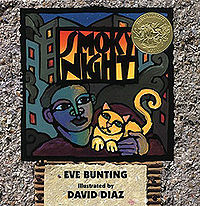
Smoky Night

and if you want to hear more about children's and young adult literature, definitely check out the very excellent blog: The Classroom Bookshelf: Teaching with Children's and Young Adult Literature in the 21st Century.

over the next several months, i'll be sharing reflections on the many ways i continue to witness the joy for stories that larry held and shared as they thrive in the practices of the many young people i've spent time with these last several years. in part, this will be a part of the collection of essays i am preparing along with my research team in a book about bringing an arts-based approach to digital media in literacy explorations with youth, particularly court-involved youth. and other vignettes will be drawn from a book length manuscript i'm working on based on five years of ethnographic research at the program i've called ATIP in various publications.

for now, though, i'll take in the jouissance that comes with recognizing the beauty of a beautifully crafted page, made of pastels and paint and cutouts and hours of labor...

3.10.2010

Multimodality and Learning Conference - 2010 - deadline extended!


Extended Deadline: March 12, 2010

Aim and scope
The overall aim of the conference is to explore multimodal perspectives on learning and to open up theoretical, methodological and pedagogical questions and debate.The conference will be of interest to educational practitioners, research students,researchers and academics from a variety of disciplines including semiotics, linguistics, sociology, anthropology and design.


1.30.2010

CFP: Visual Interpretations conference at MIT

humanities + digital conference 2010
"Visual Interpretations" - Aesthetics, Methods, and Critiques
Of Information Visualization in the Humanities, Arts, and Social Sciences
May 20-22, 2010 at Massachusetts Institute of Technology/HyperStudio

http://hyperstudio.mit.edu/h-digital/

How do visual representations of complex data help humanities scholars ask new questions? How does visual rhetoric shape the way we relate to documents and artifacts? 

And, can we recompose the field of digital humanities to integrate more dynamic analytical methods into humanities research?

HyperStudio’s Visual Interpretations conference will bring digital practitioners and humanities scholars together with experts in art and design to consider the past, present, and future of visual epistemology in digital humanities. The goal is to get beyond the notion that information exists independently of visual presentation, and to rethink visualization as an integrated analytical method in humanities scholarship. By fostering dialogue and critical engagement, this conference aims to explore new ways to design data and metadata structures so that their visual embodiments function as "humanities tools in digital environments.” (Johanna Drucker)

We welcome submissions from practitioners and theorists of digital humanities as well as such connected disciplines as art, design, visual culture, museum studies, and computer science.

Topics include:
·       Expressive and artistic dimensions of visualizations
·       Subjectivity and objectivity in information visualization
·       Dynamic/multidimensional visualizations and user collaboration
·       Social media and contextualized visualization
·       Cultural history of visual epistemology
·       Limits and affordances of the translation from data to visualization
·       2D and 3D visualizations of historical/social/political data
·       Visualization across media and the archive
·       Digital visual literacy & accessibility
·       Relationships between database and interface
·       Alternative modes of data representation.

Submissions:
We are inviting submissions for the following conference formats:
·       Papers with 15 minutes of presentation and short discussions (12 slots)
·       Short presentations, so called “6/4s” with 6 minutes of presentation and 4 minutes of discussion (18 slots available)
·       Mini-Workshops, 30 minutes each (6 slots)
·       Demos and Posters (30 slots)

Deadline for submissions:  March 31, 2010
Organizers:
MIT HyperStudio for Digital Humanities (http://hyperstudio.mit.edu)
MIT Communications Forum (http://web.mit.edu/comm-forum/)

For more information: http://hyperstudio.mit.edu/h-digital/ or contact: h.digital@mit.edu

11.03.2009

new book about harlem, youth, and multimodal literacy


Harlem on our minds: Place, race, and the literacies of urban youth
by Valerie Kinloch
Teachers College Press, 2009

Discourses of youth, gentrification, place, space, and literacies converge beautifully in this volume, collaboratively constructed by Valerie Kinloch and youth researchers, who explored changes going on in Harlem through a variety of modes, discursive interactions, and ongoing inquiry.

Definitely explore and purchase for your own reading, or to read with youth, undergraduate and graduate students interested the complicated intersections of identity, place, power, and narrative discussed in this book.


From the publisher:
In her new book, Valerie Kinloch investigates how the lives and literacies of youth in New York City’s historic Harlem are affected by public attempts to gentrify the community. Kinloch draws connections between race, place, and students’ literate identity through collaborative interviews between youth, teachers, longtime black residents, and their new white neighbors. Harlem on Our Minds is a participatory action narrative that makes emerging theories of social ecology real for the high-school English classroom. Vividly drawn lessons show how teachers can engage urban youth in school-based literacy, by linking canonical text, particularly of the Harlem renaissance, to current events. Centered on the literacy stories of two African American youth and their peers, this book for our times:
  • Showcases the multimodal literacy practices of urban youth through photos, writing samples, student-designed research projects, and more.
  • Weaves in multiple voices and perspectives through response pieces by project participants, local teachers, graduate students, and a community activist.
  • Features teaching strategies and reflection points in each chapter.

10.25.2009

digital media and learning conference - call for papers, deadline: 10.30.2009

DML: First Annual Digital Media and Learning Conference
Conference Theme: "Diversifying Participation"
Call for papers - Deadline: October 30, 2009


Conference Committee: Henry Jenkins, David Theo Goldberg, Heather Horst, Mimi Ito, Jabari Mahiri and Holly Willis

Keynote speakers: Sonia Livingstone and S. Craig Watkins

(from the call)

DIVERSIFYING PARTICIPATION
A growing body of research has identified how young people's digital media use is tied to basic social and cultural competencies needed for full participation in contemporary society. We continue to develop an understanding of the impact of these experiences on learning, civic engagement, professional development, and ethical comprehension of the digital world.

Yet research has also suggested that young people's forms of participation with new media are incredibly diverse, and that risks, opportunities, and competencies are spread unevenly across the social and cultural landscape. Young people have differential access to online experiences, practices, and tools and this has a consequence in their developing sense of their own identities and their place in the world. In some cases, different forms of participation and access correspond with familiar cultural and social divides. In other cases, however, new media have introduced novel and unexpected kinds of social differences, subcultures, and identities.

It is far too simple to talk about this in terms of binaries such as "information haves and have nots" or "digital divides". There are many different kinds of obstacles to full participation, many different degrees of access to information, technologies, and online communities, and many different ways of processing those experiences. Participatory cultures surrounding digital media are characterized by a diversity that does not track automatically to high and low access or more or less sophisticated use. Rather, multiple forms of expertise, connoisseurship, identity, and practice are proliferating in online worlds, with complicated relationships to pre-existing categories such as socioeconomic status, gender, nationality, race, or ethnicity.

We encourage sessions that describe, document, and critically analyze different forms of participation and how they relate to various forms of social and cultural capital. We are interested in accounts of the challenges and obstacles which block or inhibit engagement to different forms of online participation. We also encourage session proposals that engage with successful intervention strategies and pedagogical processes enabling once marginalized groups to more fully exploit the opportunities for learning with digital media. Conversely, we are interested in hearing more about how marginal and subcultural communities find diverse uses of new and emerging technologies, pushing them in new directions and navigating a complicated relationship with "mainstream" forms of participation. Specifically, we seek to understand the following:
  • What can research on more diverse communities contribute to our understanding of the learning ecologies surrounding new media?
  • What are the technologies, practices, economic, and cultural divides that lead to segregation, "gated" information communities, and differential access?
  • When and how do diversity and differentiation in participation promote social and cultural benefits and opportunities, and when do they create schisms that are less equitable or productive?
  • What strategies have proven successful at broadening opportunities for participation, overcoming the many different kinds of segregation or exclusion which impact the online world, and empowering more diverse presences throughout cyberspace?
  • Are there things occurring on the margins of the existing digital culture that might valuably be incorporated into more mainstream practices?
In addition to these questions directly addressing the conference theme, we welcome submissions that address innovative new directions in research and practice relating to digital media and participatory learning.

Read more on conference website.

.

10.03.2009

bar code art

taking something meant to be invisible or what goes unnoticed and repurposing it by (re)imagining it as a modality for creating art. fantastic!

7.13.2009

knowing by doing?

as fears about the dark side of social networking abound, one question continues to persist for me: to what extent does someone (a researcher of adolescents' literacies, for example) benefit from participating in the digital communicative landscape when aiming to make sense of that landscape within the lives of aforementioned adolescents?

i recall having a similar conversation about gaming and literacy research and wondering whether one had to play video games in order to research gaming in the lives of youth. thinking back to that conversation now, i am reminded of a video i saw recently on edutopia in which mimi ito is being interviewed about her digital youth study. in it, ito describes three ways that she observed youth engaging in informal learning outside of school with technologies:
hanging out
messing around
geeking out

each of these "ways in" - what ito and her colleagues refer to as "genres of participation" - is associated with various sets of practices and postures and social communities. as i thought about these distinctions (see video and full report for on these genres), i began to wonder about how researchers fit into (or don't) these participation genres. and to what extent and in what ways do we locate ourselves within these already hybrid spaces and moments of digital participation...

6.06.2009

new (literacies-related) reads on my summer 'must read' list

The Routledge Handbook of Multimodal Analysis (Routledge) - Edited by Carey Jewitt - out July 2009

Assessing New Literacies: Perspectives from the Classroom (Peter Lang) - Edited by Anne Burke & Roberta Hammett (and part of the New Literacies & Digital Epistemologies series edited by Colin Lankshear & Michele Knobel)

The Word and the World: The Cultural Politics of Literacy in Brazil (Hampton Press) - Lesley Bartlett

Handbook of Adolescent Literacy Research
(Guilford Press) - Edited by Leila Christenbury, Randy Bomer, & Peter Smagorinsky

any other suggestions??

5.05.2009

insight project presents: bird's eye view - a youth theater performance


The youth theater company,
the Insight Project, presents:

Bird’s Eye View

A staged reading followed by a discussion
of Justice and the Arts

Details:
Friday, May 8th @ 7:00 pm

@ Cowin Center - Teachers College, Columbia University, 525 W. 120th St., New York, NY 10027


Synopsis:
David’s got problems - a rap sheet, a schizophrenic uncle, and a pregnant girlfriend, just to name a few - and his friends’ solutions may be more trouble than help. How does a young man find a way to walk a straight path and still keep his head up in the streets?

Directions to the Cowin Center: Take the 1 train to 116th St., walk four blocks north on Broadway and turn right onto 120th St. Use the main entrance for Teachers College located on the north side of 120th St., between Broadway and Amsterdam. Follow signs for the Cowin Center.

The Insight Project is part of CASES CEP. For more information, go to www.cases.org

For more information about this performance, contact Lalitha Vasudevan:
email: lmv2102 AT columbia.edu | phone: 212-678-6660

4.06.2009

writing and literacies sig - website and newsletter

check out the writing and literacies sig website - join us this year for an excellent program in san diego!
also check out our latest newsletter, chock full of members' pub info, links, and info about this year's business meeting featuring eva lam and paul kei matsuda.

and now, a wordling of this year's program (based on the titles) - enjoy :)

2.23.2009

at a glance: writing and literacies sig sessions at aera, 2009

1. Genres and Structures in Writing
Session type: Paper Discussion (formerly known as Roundtables)
Time: Tue, Apr 14 - 10:35am - 11:15am Place: San Diego Marriott Hotel & Marina, Marriott Hall Salon 4

2. Hybridity, Multimodality, and New Forms of Composing
Session type: Symposium
Time: Wed, Apr 15 - 8:15am - 10:15am Place: San Diego Convention Center, Room 28D

3. Literacies Between Borders and Across Contexts
Session type: Paper Session
Time: Thu, Apr 16 - 8:15am - 10:15am Place: San Diego Convention Center, Room 28B

4. LitScapes: Mapping the Terrain of Youth Identities, Spaces, and Texts
Session type: Symposium
Time: Thu, Apr 16 - 10:35am - 12:05pm Place: San Diego Convention Center, Room 28B

5. National Conference on Research in Language and Literacy Presents Authors of Its Series “On…” Series
Session type: Interactive Symposium
Time: Thu, Apr 16 - 2:15pm - 3:45pm Place: San Diego Convention Center, Room 28B

6. Sociocultural and Historical Perspectives on Literacy
Session type: Paper Session
Time: Thu, Apr 16 - 2:15pm - 3:45pm Place: San Diego Convention Center, Room 25B

7. Theorizing and Implementing New Directions in Writing and Literacy Research
Session type: Interactive Symposium
Time: Wed, Apr 15 - 2:15pm - 3:45pm Place: San Diego Convention Center, Room 28D

8. Twenty-Five Years of New Literacy Studies: Looking Back and Looking Ahead
Session type: Symposium
Time: Wed, Apr 15 - 10:35am - 12:05pm Place: San Diego Convention Center, Room 28D

9. Writing and Literacies SIG Business Meeting
Session type: Business Meeting
Time: Thu, Apr 16 - 6:15pm - 8:15pm Place: San Diego Convention Center, Room 28B

10. Writing Identities
Session type: Paper Discussion (formerly known as Roundtables)
Time: Tue, Apr 14 - 11:25am - 12:05pm Place: San Diego Marriott Hotel & Marina, Marriott Hall Salon 4

12.16.2008

Youth Theater Performance - this week in NYC!

Insight Project Presents a Staged Reading of Brazil, December 16-18

Insight Project is a comprehensive theatre-making class offered by the Court Employment Project (CEP), an alternative-to-incarceration program addressing the needs of court-involved youth at CASES. CASES Insight Project presents Brazil - a powerful meditation on hope and the distances between action and intention in the lives of seven young New Yorkers. Brazil will be presented as a staged reading from December 16-18th at 8pm, in the Lion Theatre at Theatre Row Studios, 410 W 42nd St, located between 9th and 10th Avenues.

For many of the student actors, Insight Project is their first exposure to theater, and their first experience having a public platform where they can communicate their personal narratives. The past performance cycle included five shows seen by a total audience of over 250 people.

Insight Project uses performance to engage communities in a conversation about the underlying issues of offending behavior. Insight Project student actors work collaboratively with writer-in-residence Todd Pate to create a script reflective of their resilient life experiences. Each cycle produces an original peformance exploring themes that come out of directed improvisation sessions with the company, writer-in-residence and CASES staff. Alumni receive support services as they further their performance interests, as well as personal and vocational goals. Insight Project is directed by CEP teacher Daniel Stageman.

Brazil runs three nights at the Lion Theatre at Theatre Row Studios, 410 West 42nd Street (between 9th and 10th Avenues), on December 16th, 17th, and 18th at 8pm. As the event will be presented as a staged reading, tickets are now free, though an RSVP is appreciated via phone at 212.279.4200, or online at www.ticketcentral.com listed as Insight Project presents: Brazil. Subways are A,C,E to Port Authority; N,R,Q,W,1,2,3,7 to Times Square.

***
CASES--THE CENTER FOR ALTERNATIVE SENTENCING AND EMPLOYMENT SERVICES, INC.
The mission of CASES is to increase the use and understanding of community sanctions that are fair, affordable, and consistent with public safety. www.cases.org .
***

9.19.2008

visualizing data

i saw this a while ago in nytimes and facebooked it, but have begun exploring it anew this week:

Many Eyes: http://services.alphaworks.ibm.com/manyeyes/home - presents ideas about how to visualize sets of data, including using wordle.net and other nifty apps.

7.22.2008

"real cost of prisons project" - comics

in what amounts to a happy accident, i learned about about these graphic novels that are a project of the real cost of prisons project. each offers another dimension of insight into the social and financial economics involved in the prison industry. they are available as pdf (by clicking on the links) and also in bound comic format. the titles:

Prison Town: Paying the Price

By Kevin Pyle and Craig Gilmore

Prisoners of the War on Drugs
By Sabrina Jones, Ellen Miller-Mack and Lois Ahrens

Prisoners of a Hard Life: Women and Their Children
By Susan Willmarth, Ellen Miller-Mack, and Lois Ahrens

see the site for more info on the comics, excellent 1-pager flyers (like the one below - click to see image full size), and more on the project.


from flyer:
national average cost to imprison a person for one year: $ 29,041

national average cost of one year of community college: $1,518