Showing posts with label youth. Show all posts

1.28.2015

The Curious Case of Vidal and the Stranger with the Camera


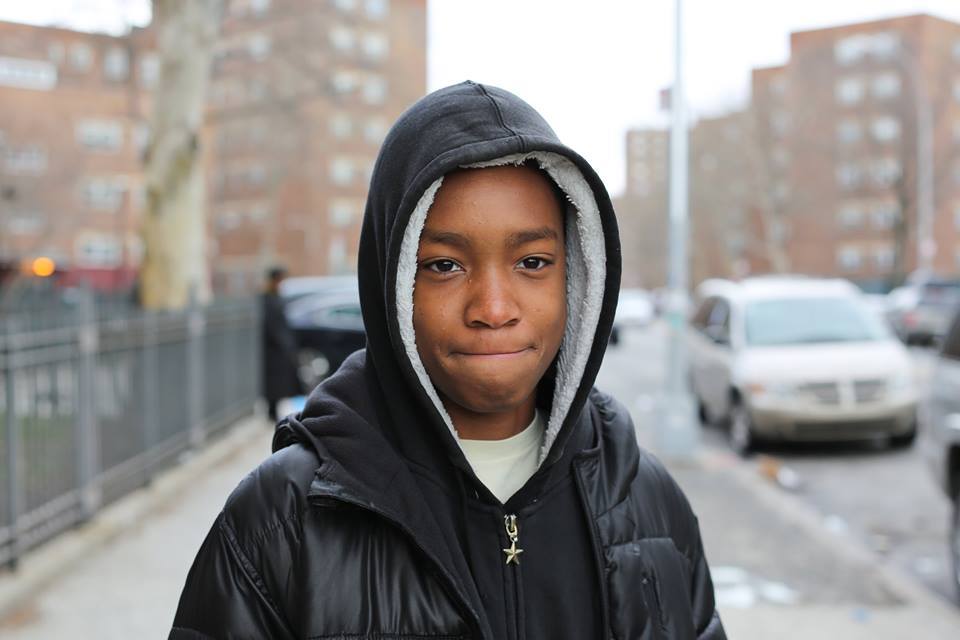
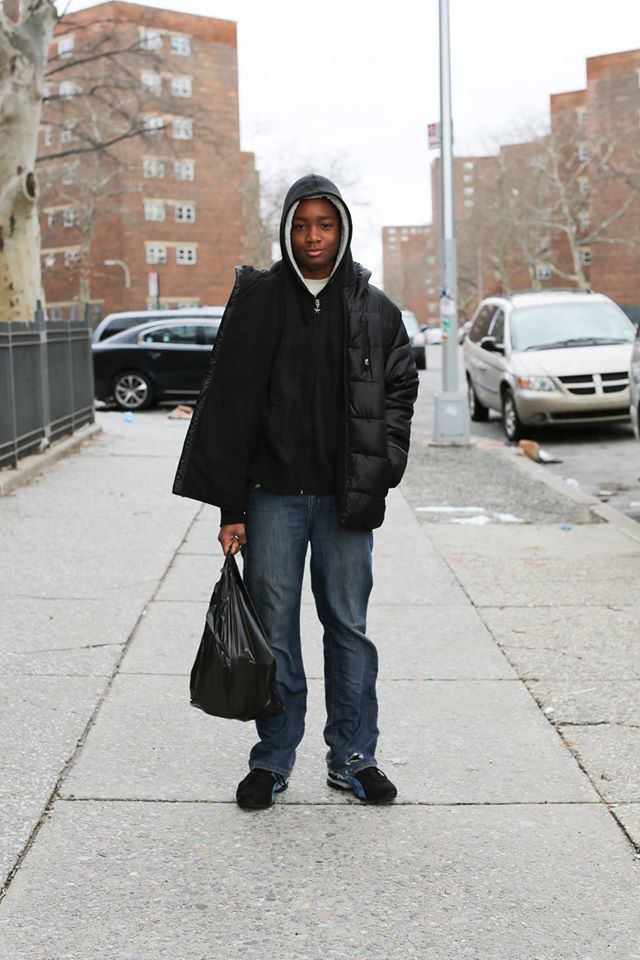
Vidal is a student who attends Mott Hall Bridges Academy, a middle school in Brownsville, Brooklyn. I know this because over the last week, I have become acquainted with this young man, the school he attends, Ms. Lopez (his principal), some of the teachers at the school, and his mother and siblings. I am one of several million people who came to learn about this young man – and the constellation of people to whom he is connected, who impact him and in whose lives he has made and continues to make an impression* – as a result of a photograph taken Brandon Stanton, the photographer behind “Humans of New York.”

The story goes like this: Stanton is a street photographer who launched “Humans of New York,” a photo project in which he aims to photograph everyone in New York City. He shares his photographs on his blog and his wildly popular facebook page, which is where I first encountered his work and he had a mere few thousand followers. (That number is now nearly 12 million.)

Brandon Stanton is a bond trader turned photographer who has captured and captivated people’s attention with the simple act of creating photographic portraits on the streets of all five boroughs of New York City. But he does more than take people’s pictures. He engages them in a conversation, asks them questions, and, in the last year or so, he has been asking his subjects a rotating set of questions, among them:
  • What is the saddest moment of your life?
  • What are you most proud of?
  • What do you want people to know about?
  • What’s your biggest fear?
  • Who has influenced you the most in your life?

One day last week Stanton asked the last question to a young man with whom he crossed paths in the Brownsville section of Brooklyn.  


"Who’s influenced you the most in your life?"
“My principal, Ms. Lopez.”
“How has she influenced you?”
“When we get in trouble, she doesn’t suspend us. She calls us to her office and explains to us how society was built down around us. And she tells us that each time somebody fails out of school, a new jail cell gets built. And one time she made every student stand up, one at a time, and she told each one of us that we matter.”
"When you live here, you don’t have too many fears. You’ve seen pretty much everything that life can throw at you. When I was nine, I saw a guy get pushed off the roof of that building right there."
Of the many stories that could be told about this interaction and the series of stories and events that have unfolded since, I am most curious to know why young Vidal stopped to talk to Brandon that day.

At a time when differences among strangers are more liability than possibility, the likelihood of a young man taking up the invitation to talk by someone who does not look like him, outside of the (theoretically) safe walls of an institutional context like school, seems increasingly rare.
  • Would there have been such an outpouring of support – in the form of comments and donations – if Vidal had been older? Didn’t smile?
  • What if Vidal had selected someone other than Ms. Lopez as a big influence in his life?
  • How have the unsettling ways in which schooling is criticized, under-funded, and legislatively manhandled increased public sympathy for the daily work of educators and the young people with whom they spend their days?
  • What impact do the ongoing discussions of #Ferguson, #EricGarner, and #BlackLivesMatter have on how people are seeing/reading/responding to Vidal and to the photo-action project he inspired Brandon Stanton to pursue?
  • Did Juno (the Blizzard that could), by keeping many people at home, inadvertently drive the total closer to one million dollars?

The story has been picked by various news outlets and some of the descriptors used to tell the story (and the images and meanings they are meant to evoke) make me bristle. But I am forcing myself to weigh the bristling against the humanizing narrative that has unfolded from a single interaction – the HONY page is filled with portraits of other teachers from Mott Hall, follow-up images of Vidal, including a photo of him with his mother and brothers.

Following a conversation with Ms. Lopez, the subject of Vidal’s first interaction with Stanton, the photographer decided to tap into his millions of fans to launch a fundraiser to support some of the principal’s goals for her school and students (whom she calls scholars), among them: taking her sixth graders on a trip to Harvard and funding a summer program. The results have been staggering: the goal of $100,000 was raised in one hour. (Read the fundraising page for more info on what the monies will be used for.)

Stanton is doing two things at once with his larger HONY project: bringing forth the extraordinary that lurks behind any human encounter, while at the same time rendering ordinary that which may have been viewed only through extraordinary or sensational lenses. The photograph and the accompanying snippets of story, borne out of these human interactions, humanizes strangers and invites other strangers to recognize a glimpse of something familiar. We all have sad moments, fears, and people who have influenced us. HONY urges its fans and followers to slow down long enough to recognize the same in others, if only for a fleeting moment.

Famed photographer Gordon Parks, in a series of photographs that has been circulating recently and which are on display at the Boston Museum of Fine Arts, similarly sought to depict ordinary Black life for an assignment for Time Magazine. Time never ran the images. An excerpt from the Slate magazine article on the collection suggests why:

“In this period, Life stories were told through the framework of the white middle-class American family. When stories did appear about African-American subjects, they were either about celebrities or athletes or people in very dire straits. Parks set out with this project to really counter those stereotypes.”

I read this article the day before Vidal appeared on my Facebook feed and so the two pieces seem intertwined to me: the pursuit of rendering the extraordinary in the quotidian and offering the dignity of the ordinary to everyone.

Regardless of why and what additional questions this story raises (this could be the subject of another post -- on how education is valued, funded, supported; whose humanity is recognized, in what ways, and how we might nurture this inclination in friends and strangers, alike...), Vidal, Ms. Lopez, and the story of Mott Hall, rendered in photographs and story bits, has moved many of us – over 30,000 people have donated to the fund raiser already.

At the time of this writing, the total is $873,550 $877,477 $877,477 $877,771
$883,226 $893,512 $895,803 $929,094 $943,850 $948,990 $950,949 and increasing steadily, with people donating every few minutes. 

The donations seem to average $20, but the $5 – and even $3 – donations really lifted my spirits. I was momentarily caught up in a wave of Obama ’08 fundraising nostalgia, a campaign built on the idealism of the $5 and $10 donations. Every one can participate (provided you have a credit card).

Ok, I’m going to go and donate now before it reaches its first million.

Before I go, a few links that may be of interest:

A Pinterest Board (where I’ve curated all of the HONY portraits related to this story, as well as a number of relevant articles)


*I suspect the latter number has increased a few million-fold by now.

8.12.2013

Listening to and with the lives of adolescents

It's been far too long since I posted an entry here. I have no one to blame but myself... but for good measure I'll also give a little credit to the very long and not always voluntary todo list that consumed me for the past many months.

But another reason is a very good one -- the publication of a new volume that brings a focus of arts and aesthetics to the work my research team and I have been doing over the past several years. Arts, Media, and Justice: Multimodal Explorations with Youth features contributions from graduate students, youth researchers, arts educators, and established literacy scholars who take up various contours of the intersections of the titular concepts of the book. The book is co-edited with Tiffany DeJaynes, a wonderful colleague and friend who is up to some amazing work of her own with high school students turned budding qualitative researchers.

Building from this volume, that draws on the Reimagining Futures Project, last year some colleagues, graduates students and I launched the Youth, Media, and Educational Justice Project -- a consortium that we are building in an effort to bring participatory approaches to the study and support of the lives of court-involved youth, including the young people involved in the Juvenile Justice system with whom we have been working for the past near decade (and a bit longer than that for some of us...!) as well as young people in foster care who will likely age out while still in the the care of the child welfare system.

What, pray tell, might this have to do with adolescent literacies? In this work we are deeply informed by the basic ideas that have always grounded my study of young people's literate lives:

  • youth are engaged in myriad forms of expression and communication (thus rendering the use of "illiterate" utterly moot); 
  • found within adolescents' literacies are markers of affiliation and connection (to communities, to people, to texts, and more);
  • the varied contours of youths' literate lives are replete with evidence of their ways of knowing -- of knowing about the world, of making themselves known in the world.

We bring to this set of underlying assumptions new questions about belonging and becoming, questions that gain new urgency in the current and ongoing discourses of laws and policies that place adolescents' wellbeing at a far remove from decision making. Most notably, these concerns are brought into stark relief in the ongoing and deeply divided debates about the NYPD's #stopandfrisk policies, including today's ruling on the policy.

We take as our mission four entry points into the pursuit of educational justice for court-involved youth in which our position and posture is that of listening both to and with young people:

  • Media making
  • Mentoring
  • Research
  • Education

I, along with my YMEJ team members, will be blogging about these and related ideas over on our YMEJ blog. I encourage you to follow and also to keep up with us on Twitter.


Next up here -- a short post about some of the excellent reads I encountered this summer, all of which touched, in some way, on adolescents' ways of communicating, knowing, being, becoming, and belonging...

Wishing you a restorative August in the meantime.


1.09.2013

So that we may shame the shamers

The beginning of the autumn semester brought me into contact with Jessica Ringrose's research on sexting and the related practices of shaming going on in the daily, digitally mediated practices of some adolescents. This past month has brought into stark relief the ways in which shaming and symbolic violence are manifested as actual, heinous, unimaginable violence and violation of another human being. 

Here, I've curated a selection of artifacts -- articles, media, and more -- that touch on various aspects of shaming. These aren't intended to sensationalize, glorify, or horrify. They are meant, simply, to educate, inform, and generate further inquiry. I'll continue to add more over the next few weeks, as well.
  • On "slut-shaming" -- a collection of cites inspired by a youth-produced radio piece 


5.25.2012

adolescents and literacies - a few headlines to ponder

Headlines that caught my eye this week, which, because of other looming deadlines, will remain on the back burner... for now.

And a project that has me scratching my head, pulling out my beat up copy (no pun intended) of Discipline and Punish, and just feeling a bit uneasy all around: What does the geography of incarceration in the United States look like? - @joshbegley via @jamilahking


Just because I haven't had time to further ruminate and comment, doesn't mean you can't enjoy some food for thought.


5.06.2012

Being present as youth musicians come "into presence"

"Text of bliss: the text that imposes a state of loss, the text that discomforts (perhaps to the point of a certain boredom), unsettles the reader’s historical, cultural, psychological assumptions, the consistency of his tastes, values, memories, brings to a crisis his relation with language."
—  Roland Barthes, The Pleasure of the Text, trans. Richard Miller


I saw the orange of his plaid shirt and the shine on his trombone before I saw the young man who wore both as extensions of his being, as he made his way to his awaiting family through the narrow passageway between the auditorium seating and the doors leading to the outdoor courtyard. A woman standing beside me against the wall between two open doors exclaimed words of congratulations to the boy, noting that the afternoon’s orchestral performance was “wonderful,” and “great!” The boy’s face showed a serious expression. “I only had to sight read the first piece.” He repeated himself and then explained with conviction, “I knew the rest, I just had to sight read the first piece.” The woman next to me beamed with a measured yet joyous pride as she told me of her grandson’s multiple musical accomplishments, that in addition to playing the trombone and the violin, he was more than adept at the drums, which he started playing at the age of five. The young man was just ten, and the roundness of face matched his age even as his maturing body belied his status as a musician still in elementary school. “They had him tested when he was five,” the grandmother continued, “and they told us he played [the drums] better than most twelve-year-olds. And now he wants to learn the piano.” I had barely finished uttering my “Wow” before she added two thoughts that made me wish I could stay and talk with her more extensively. First, she noted that music was in his blood, an influence of his grandmother. Then she smiled. It was a shy smile that she followed up by proudly stating that she was a graduate of Settlement Music School, a singer, who had been a member of a professional singing group. She paused momentarily – I suspected that it had less to do with allowing me to digest all of these fantastically intricate pieces of information that begged for follow-up, and everything to do with taking a moment to revel in that memory before continuing to regale me with tales of grandmotherly adoration – and when she continued she said, with a sort of excited urgency, that she, who had come from Delaware to see him perform, was encouraging him to “learn all the instruments!” Learn as many as he could, was her advice to her young, talented, earnest grandson. And within seconds they – the young man in his pumpkin orange shirt and his grandmother who was the picture of spring in deep purple – were in the slow but steadily moving line of humanity edging toward the stairs that led to the courtyard reception below.

This was a mere glimpse into the many stories in the lives of one young musician who was among the nearly three hundred who performed as part of the 2012 El Sistema Seminario concert held at West Catholic High School yesterday. Present were members from eight different youth orchestras from as near as Philadelphia’s own Play On, Philly! and as far away as Durham, NC and Newport News, VA, all of whom shared the ethos of the El Sistema global youth music movement. As I walked out, my mind filled with questions I might have asked and wish I could have asked the musicians, the parents, and other family members, the passers-by who happened to attend. I was struck by the way the young musicians worked and played together, the mutual allegiance youth and adults seemed to have for one another, and observations and thoughts about the silly debate that goes on in education policy about “the arts” – clearly anyone who marginalizes art-making and art-being has never attended a youth orchestra! But first, let’s go back to the beginning.

It was 4:54 pm when I arrived at the high school where I’d never been before despite spending many years living and later working with youth in the same neighborhood. Across the street is a mural of Paul Robeson and the side entry where a woman dressed in black from head to toe was handing out programs was lined with murals whose once vibrant colors had faded over time. Art was everywhere, for anyone who cared to notice.


Ascending the outdoor metal stairs to the auditorium level, I heard familiar sounds that increased in volume with each step and were fully amplified as I walked in and found an empty aisle seat a few rows from the front. The stage was overflowing with young people clutching their violins, waving bows in the air, responding with waves and smiles in the direction of family members who were doing the same as they desperately tried to get their child's attention from various vantage points inside the large room. In the audience, families quieted younger children and some searched for, then photographed names they recognized in the program. Near the stage, adults, all of whom were also dressed casually like the youth – most wearing jeans, that universal garment that has come to function as both uniform and talisman of ease in a bevy of uncertain social situations – attended to what looked like last minute requests and preparations. In one corner, a group of young women was singing softly and swaying smilingly; behind them two young men stood at the ready behind basses that towered over them; and from one corner of the large room to another, waves of shushing continued – it wasn’t altogether clear who was doing the shushing and who was being shushed.

And then suddenly a voice cut through the ambient chattering and shushing instructing everyone to be quiet so that the concert could begin. The room fell as silent as a room full of people sitting together in a slightly warm auditorium with overhead fans doing their best to cool the room could. Stanford Thompson (@stanfordleon), the director and founder of Play On, Philly! (@playonphilly) took the microphone and, after offering a note of thanks to a woman named Ms. Naomi who had quieted us down, provided a few words of introduction before turning to the eager faces in front of him. He told the audience, made up people of all ages who seemed to have some tie to what felt every bit like a human movement, that there were nearly three hundred students on stage, that people had traveled near and far to be here, and that what we would hear during the “short concert” were pieces that the large group had been practicing as individual groups and more recently as a massive, whole orchestra. He then thanked the parents and teachers who enabled this concert to happen. Loud applause. To introduce the first piece, Thompson, also wearing jeans and a tan, lightly striped tee shirt, simply described it as a “collection of songs you’ll all know.” He then turned to the expectant orchestra and said “Spiritual Melody” before handing the mic to someone and standing on top of wooden chair so that he could be seen by the whole group.

Thompson energetically signaled for the group to start and the first notes came streaming out – strings, woodwinds, and possibly the tingling cling of the triangle, which had a starring role throughout the concert. Even as I should have known the first piece, recognition eluded me so I just enjoyed watching the performers, only about a third of whom were playing at first. Others looked on, predictably waiting for their turn to join the composition in progress. The orchestra easily transitioned into the second selection, a rendition of “Ava Maria,” and I think the pair of women sitting behind me as well as a few others in seats several rows to my right were singing along. The little boy next to me looked at the women behind us, then looked at me and we both smiled. Now this was a concert.

It was during the third selection when I noticed the violinist who played the music with her whole body. With each measure, she bloomed with musical energy that matched the vibrancy of her fuchsia top and matching flower hairpin.  She bent from side to side, swaying as she applied vibrato to coax a few more decibels from her violin strings. In between numbers, her horn-rimmed glasses remained fixed on the music stand in front of her that she shared with a bespectacled fellow musician whose muted, pastel striped shirt belied the animated personality that was on display after the concert. The selection of spiritual songs ended as more applause erupted from the grinning and altogether charmed audience. It was then that I noticed the cameras blanketing the aisles, held in varying lengths from people’s faces and serving as filters through which many of my fellow music lovers – at least for the afternoon that’s what they were – were receiving the music.

The second piece was conducted by Rey Ramirez from the Soundscapes orchestra program in Newport News, VA, who will be the hosts for next year’s concert extravaganza. He led the group in a performance of Louis Armstrong’s “What a Wonderful World.” It is fair to say that feeding off the energy of engaged young people already puts me in a truly blissful mood, but when a subset of the orchestra broke out into song and married the lyrics with the instrumentals, I fought hard to keep the bliss from pouring out of my eyes. The players-turned-singers were led by a woman wearing a sleeveless, black dress and was the owner of sculpted upper arms who, like Thompson earlier and Ramirez, who also stood on the wooden chair beside her, conducted with exuberance. The boys and the girls sang with earnest, a few closed their eyes when they were trying to hit a high note or hold a long note, and still others smiled with a combination of shyness and pride. And I’d be lying if I didn’t admit that I, too, sang along for a few bars.


Before the third and final piece started, Thompson introduced yet another conductor, Dan Trahey who leads the Tuned In orchestra in Baltimore. Trahey started off with some shoutouts to the various cities represented in the orchestra and in the seats as audience members gleefully obliged by cheering when their city was called including New York, Philadelphia, and Baltimore. He then offered a few more words about the mission of this collaborative effort to increase access to music and to “get music into kids’ lives.” This work, he noted, was motivated by a desire to “change kids’ lives and society through music” noting that present in the multi-orchestra group in front of us were young people from “different races, different genders” – suggestive of a microcosm of the nation and world, more broadly. This last observation elicited not only cheers and applause, but a few Arsenio-type rolling fist pumps in the air.

The last piece, Finlandia, had a thunderous beginning that heavily featured the percussionists, and it was while paying attention closely to the way the beginning unfolded that I noticed the various ways in which adults were peppered throughout the orchestra: as musicians, as page turners and enthusiastic cheering squads. In this piece, too, as the music fell almost completely quiet except for a solo (an oboe, perhaps? My ear is a bit off, so pardon the uncertainty here!), the singing began. While holding their instruments, some looking directly ahead, others looking at each other, and still others making eye contact with loved ones, the musicians became singers once more and delivered lyrics of peace, of hopes and dreams. They were what they sang. And we the audience, appropriately moved, leapt to our feet as the last note evaporated into the air. More fist pumps, more cheers, a parade of cameras (including the man in the front recording the performance with his iPad) and applause.


The adults, the youth, the families and supportive audience members – they were all players in this performance, each one somehow committed to the success of this afternoon, wherein success was neither tested nor measured but plainly observed, felt, and celebrated. The violinist in fuchsia, the trombone player in orange, and the bass player with the black pants and matching vest – each of these young people and their many fellow youth orchestra members are part of a beautiful story that is being written through music. Not all of them will become musicians, but they each, at least for a short time, will have had music in their lives in a most intimate way. And yesterday afternoon, through music, they brought joy into the lives of a few hundred others.

I write these words from a vantage point of an educator and researcher of young people’s lives, their literate practices, and their creative endeavors. And being in the presence of these young musicians this weekend and last weekend has brought the ever-present education angst into sharper focus. The rhetoric surrounding schooling seems to move ever further and further away from education. The discourse has become – or rather continues to be – saturated with band-aid “solutions” about how to “fix” a system that is presupposed to be a complex if/then statement premised up readymade packets of information and methods of digestion and evaluation. But the more I read -- academic and popular publications, alike -- the less I see any sense of purpose in how school is being understood. That is, there seems to be no imagination or consideration about how to escape a pre-ordained sense of what schooling should be and thus an inability to move beyond “doing school” as the “simple insertion of the human individual into a preexisting order.” And I can’t help but think of the theme song from “Kids are people, too.” It’s really as simple as that – kids are not less than people. They are people. Period.

In spaces, like Play on, Philly! and the other El Sistema-inspired youth orchestras, where young people are taken seriously and invited in to explore oeuvres and create their own – artistic and otherwise – there appears to be education occurring wherein education might be seen as a “focus on the ways in which the new beginning of each and every individual can come ‘into presence.’” Gert Biesta, from whose book Beyond learning: Democratic education for a human feature, argues for an education that nurtures every-one's coming into presence and, one might argue, an education that is nourished by pedagogical trust. In doing so, he implicitly honors and extends the words from Hannah Arendt that are included as an epigraph to his book:
“Education is the point at which we decide whether we love the world enough to assume responsibility for it, and by the same token save it from that ruin which except for renewal, except for the coming of the new and the young, would be inevitable. And education, too, is where we decide whether we love our children enough not to expel them from our world and leave them to their own devices, nor to strike from their hands their chance of undertaking something new, something unforeseen by us, but to prepare them in advance for the task of renewing a common world.” 
To notice and to be seen, to listen and to be heard, to be expected to work hard (not simply because others have done so or because that is what one is supposed to do, but because each individual contributes to the larger whole), to come into presence – a system seems too large of a unit of analysis at times, so for the time being I will seek out smaller spaces that allow young people to pursue these goals that may allow each of them and each of their stories to “come into presence” in whatever way seems right, and seek bliss in the process.. To wit, Ammons’ poem seems an apt place to pause for now:


Poetics, by A.R. Ammons


I look for the way
things will turn
out spiraling from a center,
the shape
things will take to come forth in


so that the birch tree white
touched black at branches
will stand out
wind-glittering
totally its apparent self:


I look for the forms
things want to come as


from what black wells of possibility,
how a thing will
unfold:


not the shape on paper -- though
that, too -- but the
uninterfering means on paper:


not so much looking for the shape
as being available
to any shape that may be
summoning itself
through me
from the self not mine but ours.


4.29.2012

Moved to the Point of Trust: On Simon Rattle, Musical Magic, and Play on, Philly!


Simon Rattle astounds me. Pure serendipity first put me in his presence nearly fifteen years ago, brought me to a seat in the fourth row of the Academy of Music in Philadelphia where Rattle was conducting Mahler's Symphony No. 2. It is a moment for which I am eternally grateful to one of my college friends who had suggested a group of us attend and to the Philadelphia Orchestra for their student voucher program. (They came in a book of five or ten vouchers back then that could be exchanged for tickets on the night of a concert.) I didn't hear the music that night so much as it consumed me. Orchestral maneuvers had never moved me as much, despite an entire childhood spent playing in school orchestras complete with weekly rehearsals, bi-annual concerts, and yearly competitions. Rattle became fused that night not only with Mahler, a composer whose works until then I had enjoyed but had not yet been so utterly transfixed by, but also with an unchecked exuberance and bliss-filled joy -- so much so that after I glided back to my apartment that night, I unearthed the violin bought for me when I was nine years old from its tattered, black case and played a few measures each of the South Pacific Overture and the first movement of Bach's Brandenburg Concerto No. 3, the only two pieces I could still play after having not touched the instrument in nearly five years.


This man with a nest of white-grey curls surrounding his head, and whose body, even from the back, wove symphonic stories in rhythm with the members of the orchestra; only the robotic among us could not be moved. From that evening, there settled within me a deep trust for this bloke called Simon Rattle and since that first time I have seen him in action on several other occasions in a few other cities and at each performance I have learned something new about music, about sound, about the art of listening simply by sitting in his audience.

Rattle conducts with anticipation and with responsiveness. He leads the musicians even as he receives the melodic sounds they produce with their instruments. He registers them -- not merely their music, but the musicians themselves -- on his face, making contact with their eyes, matching their gestures and inspiring theirs.


This week, again by the grace of serendipity, I found myself in Rattle's audience twice. Thursday evening I stood with others in the community rush ticket line in hopes of acquiring a ticket to see Rattle conduct once more. An ocean of time had passed since the last concert, and I continued to miss his guest conducting performances in both New York and Philadelphia in recent years. But on Thursday evening the line moved swiftly and it became clear that I would indeed get a last minute ticket; and the truth of it was that I didn't care at all about the program. Bach or Brahms, Rachmaninov or Mahler, and any number of lesser known composers he has brought to life with a flick of the baton and with the cooperation of the musicians in his charge -- the music impressed, leaving traces I would revisit long after the last note had been played and also evoking deep admiration at what a stage full of people could convey musically through their manipulation of carefully crafted pieces of wood, string, and metal. Watching Rattle is not an exercise of assessing the music, it is an experience of becoming an instrument yourself. Thursday night was no exception, however a profound yet simple truth struck me several minutes after we had returned from intermission. 


After completing the crowd-pleasing Brahms Symphony No. 3, Rattle dared the audience, as he so often seems to do, to go on a different sort of musical ride. This time some of us were introduced to six short movements by Anton Webern, which I will not attempt to describe here not only because I am no music critic but also because to do so will seem both self-indulgent and unstudied. I'll merely say that near the end of the fourth movement, several seconds before the dramatically thunderous concluding note -- if indeed the magnificently near-cacophonous convergence of sound that elides into nothing in response to Rattle's sudden closing of his left hand into a fist can be called a note -- a realization occurred to me in a wholly embodied way. I trusted Simon Rattle. And for the rest of the Webern composition and the equally complex, yet more traditionally symphonic selection by Schumann, my mind wandered through the tricky terrain of trust. 


The phrase that reverberated in my mind with an echoing refrain was "pedagogical trust." How utterly important and yet under-discussed in the preparation of teachers is the notion of trust. How hard won and easily lost is this all-too-important lifeline of human relationships -- the ones that move us to take risks, to veer down unlikely paths, to read and watch and listen to texts that may change our lives. And when that trust is violated, how devastating the impact can be.


But when that trust is reaffirmed, the effect is multiplicative. Such as was the case on Saturday night when I was, once again, in the audience ready to learn at the baton of Sir Rattle. But this was no ordinary performance. And while I had jokingly considered the prospect of attending all three of his Philly performances this week, I only seriously pursued the notion of a second performance when I read more about the special guests with whom he would open Saturday's performance. Play On, Philly! is a musical program for young people in Philadelphia ages six to thirteen intent on providing musical experiences and overall enrichment for its participants. But more than words, it was this clip that captured my heart.


So overjoyed was I that I arrived over two hours early for the community rush ticket "Power Hour" as it is properly called, making me first in a line that soon extended far back enough to warrant a multi-fold, snakelike arrangement. Another difference: my seat for Saturday's performance was in the Conductor's Circle, the section behind the orchestra that faces the rest of the audience inside the massive Verizon Hall. This time, I would be able to watch the visage that matches Rattle's lively conducting physicality from my vantage point of dead center in front of the conductor's podium. But something unexpected happened instead. When the bodies of the young musicians occupied the seats on the stage, where the green POP folders with musical scores had been placed on music stands for them, my eyes were transfixed on the way their presence filled the hall in a way that no group of adult musicians ever could. The poise of terror-filled nervousness, the grace of performing for so many strangers (and more than a few ready-made fans) whose applause greeted their entry onto the stage, the beauty of a bond with a fluffy-haired leader who seemed as excited as his musicians -- it was a privilege to be in their audience. Rattle took the microphone and offered a few words by way of introduction, linking Play On, Philly!, which was founded just last year, to its Venezuelan inspiration El Sistema, noting that in thirty years of the latter's existence, nearly half a million young people had become involved in youth orchestras. His projected words offered a glimpse into a deep-seated passion that lies beneath about the potential power of musical participation. (He has spoken about this and much more to reporters who have been fascinated with him, his conducting style, and his life for most of his conducting career. I especially like the interview with Ed Vulliamy and a short commentary by Phillipa Ibbotson, both in the Guardian.)


Rattle turned the microphone off, picked up his baton, and gave the first downbeat to signal the start of selections by Brahms. With these young musicians, Rattle was no less his animated, conducting self. His face registered each note, contorting at times and echoing bliss at others; his body took in each pause and staccato and rousing crescendo, and his hands moved independently of one another to speak to the strings while also bringing forth the rich sounds of the brass players. The initial tentativeness gave way to an increasingly confident performance, soothing to the ears and heart, not only to the audience but to the man in black at the center of the stage who seemed to grow a few feet during the five minute performance; or perhaps he, too, was floating. With the final note came more thunderous applause, the entire Hall on its feet, shouts of Bravo! and more than few hoots and woo-hoos. And Rattle bowing, bringing the orchestra to its feet to receive the crowd's adoration, walking out once, then twice and thrilling the audience by high-fiving one of the viola players, a young man with his braids held back in a ponytail. He thanked them, winked at the players who stood with what seemed to the outsider like a bit of shock mixed with an uncertainty about what to do next. Following Rattle's third exit the orchestra began to exit the stage, evoking yet another applause apex. 


There may be many interpretations of the events of Saturday night, but I take them to mean the following. If the people in line at the community rush ticket line were any indication, most were there for Rattle. As the man who was second in line behind me said, "If Rattle's conducting, I knew I had to get here early." Being a bit of a rebellious rock star -- or as much of one as a conductor of classical music orchestras can be -- comes with it expectations and responsibilities and what I suspect is a panoply of opportunities and choices. So what does it say about someone who chooses to spend time with young people, to not pay lip service but to work with them and conduct them, to allow himself to be impressed by them and to learn with them, to use one's fame for good -- public good and private good; Rattle, incidentally, has had a long-standing commitment with El Sistema as well, and having been a member of and then conductor of a youth orchestra himself in Liverpool and feels a strong conviction that young people everywhere, and not just a few, should be invited into intimate, instrumental dialogue with texts of the musically minded from generations ago. We can entertain the high/low culture debates later -- although, I find myself increasingly tiring of them -- and perhaps we might focus instead on the possibilities that come with nurturing encounters (with people, with texts, with moments in time, with artifacts and instruments) through music -- and arts more broadly, not just for the "sake of art" but for the sake of humanity and the humanizing spaces that materialize when one gives oneself over to a piece of music that illuminates even as it confounds, to words carefully crafted on a page by authors who invite you to read further and to make connections not otherwise evident, paint applied onto surfaces in a manner akin to catharsis that evokes multiple interpretations and a desire in the viewer to not only know more but to be transported. These are powerful seeds.


I continued to think about trust for the rest of the concert, and heard the Webern pieces differently than I had just two nights earlier. Perhaps Webern was scripting sounds that would make us appreciate the silences, or perhaps Rattle had brought in these six pieces as a way of sharpening our listening, inviting us to attend to what we hear and what we might hear if we listened. Because of an as-yet untarnished trust, I never for one minute doubted the value of this selection, and was focused instead on what I might do to enter this text that was being presented to me. What seeds were taking root with the engagement with the works of Webern? And how would the musings on sounds and silence and attentiveness bloom in my conscious mind in the days, weeks, and years to come? 

A part two to this already too-long essay will soon follow, with some musings on pedagogical trust, the occasionally mis-guided obsession with popular culture, and the unexamined meanings of culture in the practice of culturally relevant pedagogies. For now, however, I'm going to see what else I can find out about upcoming performances of my new favorite musical group, Play On, Philly!

3.18.2012

On reading and the joys of patient storytelling -- An incomplete essay


I’ve got a case of textual compulsion, I’ll tell them when they inevitably come to cart me away. I only wish I had the words when I was younger, when I would get lost in the words of others – not because my intention was to ignore my family or friends, but because the pages bound together inside the various hard and soft covers strewn haphazardly about the floor, on the shelves, and in the closet of my childhood bedroom bore keys to secret places and magical worlds where the improbable was the norm, where the norm seemed unimaginable, and where an author’s quotidian noticings of a piece of paper, pane of glass, or sounds of water splashing from an afternoon swim infused my adolescent melancholy with near-idiotic giddiness. It would be incomplete to say that I defined myself through my reading, although that statement, however trite, was true. No, it was more than that, more than stories and word paintings as a mere escape from reality or as the original Second Life. Rick Moody’s definition of textual compulsion comes close:

“it’s a joyful and exciting thing when you’re in the midst of it, textual compulsion.
true textual compulsion is that there has to be that element of sacrifice. Are you foregoing food and social relations? Are your personal relationships suffering? Are you going to read these books more or less sequentially?”

From my earliest memories, as a child and into adolescence, reading was an act through which I embraced the words and their creator (or perhaps their curator); the author was never far from my thoughts: where did she sit or stand or lounge when this image came into her mind? Was the story waiting for him or did he find his way into it? Who does this character remind her of? Was Kansas or the 7th century or a pair of green shoes or a windy day particularly important to him? Did she experience a moment like the one that Berger describes when a scattering transforms into a meaning-full constellation: “At a certain moment -- if you're lucky -- the accumulation becomes an image -- that's to say it stops being a heap of signs and becomes a presence.”

I was seven or eight years old the first time I selected a book for myself beyond the bins of books in the classroom. We – that is, my fellow classmates and I – had been escorted to the library by our teacher. (And if I am remembering correctly, this is our second grade teacher whose hair was never anything but extravagantly voluminous.) While most had chosen a book and were either sitting and reading or talking quietly with each other, I had wandered over to an unfamiliar section where the bookcases were higher – six shelves instead of three. This memory, true or not, is held in my mind’s eye much like a rubbing made from a stone carving or sculpture – textured, tactile, a once removed representation of the thing, a new thing itself. This differs from another reading memory in which I am performing my first solo read aloud of “Three Billy Goats Gruff” a couple of years earlier for my uncle who was visiting from London; this is my parents’ story, my uncle’s story, my grandmother’s story and has become a part of my mental memory box as part recall and part verbal reconstruction of the retellings of others. Charlotte Linde, during a talk she gave at Teachers College a few years ago, said of this very notion that “Our story exists in the memories and narratives of others.” And they in ours.

But that afternoon or morning in the library, Carolyn Keene felt like my own discovery and the adventures of Nancy, Bess, and George were mine to explore, free from the expectations of others. I have a constructed memory of the forest green, linen book cover with fraying, slightly yellowed corners and pages that were not pristine – evidence that more than a few someones before me had thumbed through them. Holding the book, I remember turning it around in my hands, already convinced that it would be my check out for the day, and opening to the back – not to the end of the story, an action I regard as wholly unholy within the covenant between writers and their readers, but to the inside back cover where a small, manila colored pocket had been affixed, inside of which was a white, lined card onto which names and dates had been written and crossed out with some ceremony. It’s one of the things I miss in this era of digital downloading (a club to which I happily belong). No longer are we privy to the glimpses of the lives a book was enmeshed in for a while before coming into our temporary guardianship. And it is perhaps why visiting used bookstores sparks in me a familiar sense of possibility of what might be found inside, on the shelves and table, inside the pages, tucked into book jackets. (We may never really know the secret lives of books.)

The relationship is an intimate one, between reader and writer. Amelie Rorty assumes as much in her essay “The ethics of reading” when she implores us, as readers, to consider the author’s house – a magnificent image as ever there was one for visualizing the structural integrity of words and their foundations into and out of which stories are written – in how we read a text. We are meant to investigate a text, not merely to “get the information” but also to consider how it is and was located in the life of the author, and to conceive of the author, therefore, as situated in the world. Answers to the many questions that Rorty invites us to consider in her essay are not meant to be definitive; hers is not advocacy for navigating “text complexity” – rather, we are meant, as readers, to render visible  to fall into as it were – the beauteous complexity of texts. Can there be anything more revealing than the words of others? The ones that find their way to the final publication draft no doubt had countless antecedents. And to find wordsmithing that evokes joy, wonderment, and a desire to reread even before the initial read is complete – how can such discoveries lead to anything but textual compulsion?

In his essay, from which I quote above, Moody was referring directly to the work of W.G. Sebald. Since first reading a few pages of The Emigrants online, at the suggestion of a colleague, I have been transfixed by Sebald’s writing. I can’t yet say with any degree of eloquence or articulation exactly why this author’s words stay with me long after I read them, and now I cannot separate the reading of his words from the extensive readings of the man; the story of his stories invite this reader in more fully, with a wide embrace. In the film “Patience (After Sebald)” by filmmaker Grant Gee, more of these authorial layers are lifted ever so slightly to allow glimpses of the author’s multiple and varied situatedness. Gee intentionally stacked his interviews with artists and in so doing created a filmic narrative that foregrounds Sebald’s artistic craft. (A favorite image is one that a colleague of Sebald’s constructs as he recalls the author’s practice of taking photographs with highly precise lenses, taking them to be developed at the local pharmacy, Boots, and then copying them again and again, sometimes literally taking an eraser to the copies in order to create just the right amount of blurring; with both images and words, Sebald artfully obfuscated even as he explicated, offered rich description in order to unsettle a reader’s complacency.)

And it was Sebald who led me to “Open City,” a book by Teju Cole that has come to be so much more than a title on my “already read” list. I have reread this book in its entirety and again in parts several times over since first learning of it through pure serendipity: a search for something Sebaldian, while I was participating in my colleague’s summer seminar in which we pored over and read closely several of Sebald’s works, yielded a list of reviews of the then-recently published Open City. What first caught my eye were the consistent comparisons made about Cole to Sebald. Having had an intense introduction to the latter, I was compelled to read the former. That simple decision, to read a book, brought me into an already-happening dialogue that the book's narrator, Julius, was having with the imagined reader (or perhaps with himself). Reading Cole, like Sebald, was a welcoming experience -- even as they offer new intellectual tributaries to follow, their prose also pulses with tropes that, while seemingly familiar, resonate precisely because they are largely unexplored. Reading their words was very much like discovering a secret that begged, at once, to be closely guarded and also to be shared with the world. As a reader, I had a full sense of belonging. I daresay in their words – words that journeyed far to bring the world nearer  I found a home. learned quickly, however, that it was I who was on a journey that was far from being over; whatever this was, it had barely begun. Textual compulsion was reincarnated in this moment and led to an experience of heightened awareness about myself as a reader; the lives of those who storied with grace, with measure, and with nuance beckoned through their words. And each of these authors is careful with his words. That’s not to say that their writing is guarded or distant – in fact, quite the opposite is true. The narrative in Sebald’s The EmigrantsAusterlitz, and Rings of Saturn and Cole’s Open City is unhurried, attentive, embodying what Cole himself has described as a “breathable” quality. In these texts are orchestrations of words about the lives and worlds of selves and others that reflect a deep listening to the intermingling of souls. 

A kinship relationship emerges in the work of these writers that is bound by patient storytelling and Cole and Sebald are forever linked in my mind as one led me to the other, and then back again. And so it has continued this past year as their literary conversation – as Julius talks with Max Ferber, as Austerlitz makes meaning of Cole’s small fates – plays as a nonstop reel in the backdrop of my mind while I have found my way to Kiran Desai and Muriel Barberry and Iris Murdoch and Elizabeth Bowen. Sebald’s Campo Santo moved me to read Nabakov’s Speak, Memory, and Cole’s essays – among them, his views on Aciman’s Essay on Elsewhere and more recently on Ondaatje – have furthered my journey down, up, through, and around the proverbial, even Rilke-esque, rabbit hole. And in each instance, with every textual encounter, despite what may seem like an underlying narrative of reading voraciousness, these literary perambulations have remained, as the content may suggest, unhurried and unfolding. Patience in storytelling gently demands the same of readers. (Can we allow ourselves to be patient readers?)

How, then, do some words and prose become the ones we carry with us, in ways that they become part of our waking hours and penetrate our dreams? I’m not sure entirely, but the following passage from Jens Brockmeier’s essay on memory and Sebald’s Austerlitz suggests a place to start that inquiry. 

"No doubt, Austerlitz demands a serious reader who follows attentively a meandering syntax without clear paragraph structure, a peculiar mixture of the narrative voices of the protagonist and the narrator, several layers of free indirect thought and discourse, and wide-ranging associative chains that encompass extensive accounts of very specific details that may or may not contribute to a labyrinthine plot, if we can call it a plot at all. But my sense is that this book is puzzling not only because of its demanding narrative composition but also, more importantly, because it offers, in an unusual, perhaps unique way, a new view of memory and the autobiographical process."