last fall, i began my journey through the critically acclaimed scripted television series,
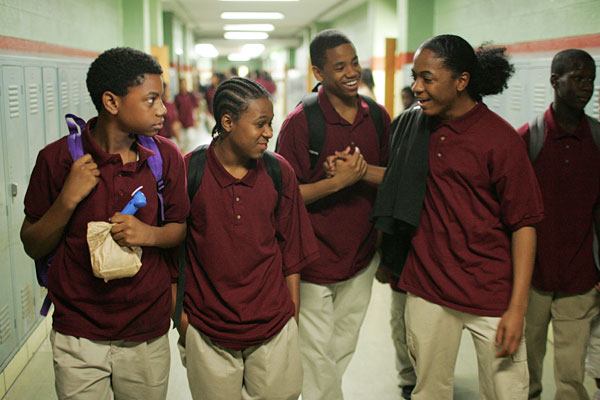
the wire. and i approached it like a homework assignment given to me by nearly everyone who hears me talk about the work i've been engaged in for almost fifteen years - participatory research with adolescents living in urban contexts, court-involved and not. so, after a rocky start - the first 3 episodes of season 1 were a shock to the system, for reasons i'll post later - i finally arrived at season 4, commmonly referred to as "the education season" in which the series regulars continue their march against corruption, the drug wars, and the ongoing bevy of crime-related activities, while a group of middle school students is introduced in the summer before they return to school as eighth graders.
prior to delving into season 4, i quickly read
the first in a series of commentaries written by sudhir venkatesh, a sociologist at columbia, as he watched season 5 with "real thugs" - i only skimmed the piece because i did not want to learn too much about the last season before completing the penultimate one. but the ethos of the series - he wrote a commentary after each episode in season 5, viewed alongside men who he had come to know through his research, particularly focused on the underground economy of the drug trade - intrigued me. what would it mean to watch a popular television series depiction of how the systems of education and justice intersect a little too seamlessly in the lives of middle school youth?
i've seen the first episodes in the season, thus far. having invested three seasons in the morality, motivations, and histories of the primary characters, i find myself reading the scenes much differently than if i had started watching with this season. this seems obvious, but also important to note given how often we - the general public - are quick to make judgments - about tv characters, passers-by, acquaintances - without knowing much about them.
and now a confession. there is a scene in the first episode of season 4 where a group of about 6 adolescent boys, who are patiently trying to capture a white dove in order to sell it for a profit, accost a similarly aged boy who has made a noise and scared away the bird. as i watched the boys hurl insults about the single boy's clothing, family life, lack of money, presumed lack of utilities like running water, heat... i had to turn away. my faucet-like tear ducts were in overdrive and i had to pause the dvd momentarily and decide whether i could go on. certainly, this would not be the worst actions depicted in the season, nor in the series thus far. yet, the cruelty of children - regardless of their physical maturation - was the aspect that hurt me (in not entirely unexpected ways) more than others. i suspect this is, in part, due to the fact that i have also witnessed similar discursive moments in my work with young people, and it's the one thing - the words of hurt - that continue to mystify me the most... but also in part because of the possibility and promise that a young face holds.

baldwin's words in "
my dungeon shook..." ring loudly in my head. what are the contexts we are all born into, and how do those outside of our contexts read and interpret us based on assumptions about the contexts into which we were born?
in one scene from the third episode, a former police officer experiences his first days as a teacher. he is teaching 8th grade math and struggles to be heard, occasionally receiving the help of one student, randy, who manages to make the situation work for him - grabbing a large stack of hall passes from the teacher's desk on the first day, and quietly exiting the classroom when one girl slices another's face, causing the teacher to panic and freeze, while another, more experienced teacher, walks in and tells one of the students to call 911. the young woman, who caused her classmate to writhe in pain as the floor becomes saturated with her blood, sits scowling against the back wall with her knees clutched up near her chest. the boy who was the object of the verbal insults in episode one - duquan, who is called dukey - slowly approaches her and sits down next to her. he uses a personal fan, which he found on the ground on his walk to school on the first day, to literally cool her off.

there are so many potential opportunities to point fingers in this moment: at the girl who kept taunting her classmate until she snapped; the young woman who called on violence as a means of response; the other students who encourage antagonistic behavior in their peers; the teacher who didn't have enough awareness about what was happening in the class to intercede sooner; new, un-certified teachers, who are placed in large classes with little or no teaching experience because our urban schools are in desperate need of math and science teachers; large class sizes that are not conducive for effective learning (regardless of claims that "the studies don't bear out" effectiveness of small class size)...
with a change in administration, we are sadly seeing what is amounting to "more of the same" as programs like "race to the top" and measures of accountability only serve to reify the primacy of quantifiable, discrete, and isolated skills. the communities of practice we see in
the wire are intertwined, interdependent, situated, and contextual; tethered to local and global discourses, and yet like the kids on the screen, youth across the country continue to be reduced to statistics: % of students eligible for free and reduced lunch; # of dropouts and truants; reading grade levels; state assessment percentiles...
who is really benefiting from all of these "changes"?