Showing posts with label media. Show all posts

1.28.2015

The Curious Case of Vidal and the Stranger with the Camera


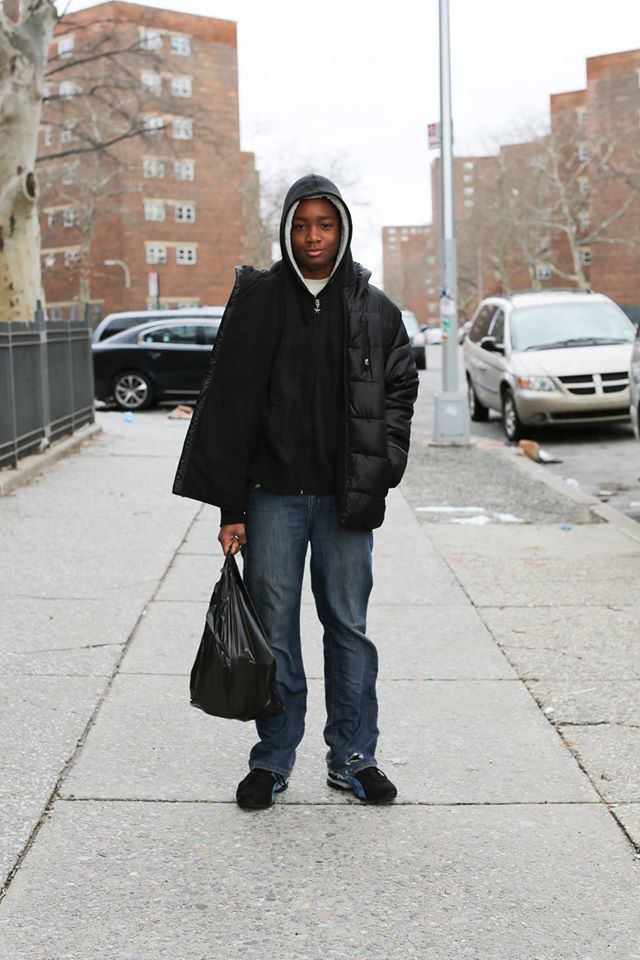
Vidal is a student who attends Mott Hall Bridges Academy, a middle school in Brownsville, Brooklyn. I know this because over the last week, I have become acquainted with this young man, the school he attends, Ms. Lopez (his principal), some of the teachers at the school, and his mother and siblings. I am one of several million people who came to learn about this young man – and the constellation of people to whom he is connected, who impact him and in whose lives he has made and continues to make an impression* – as a result of a photograph taken Brandon Stanton, the photographer behind “Humans of New York.”

The story goes like this: Stanton is a street photographer who launched “Humans of New York,” a photo project in which he aims to photograph everyone in New York City. He shares his photographs on his blog and his wildly popular facebook page, which is where I first encountered his work and he had a mere few thousand followers. (That number is now nearly 12 million.)

Brandon Stanton is a bond trader turned photographer who has captured and captivated people’s attention with the simple act of creating photographic portraits on the streets of all five boroughs of New York City. But he does more than take people’s pictures. He engages them in a conversation, asks them questions, and, in the last year or so, he has been asking his subjects a rotating set of questions, among them:
  • What is the saddest moment of your life?
  • What are you most proud of?
  • What do you want people to know about?
  • What’s your biggest fear?
  • Who has influenced you the most in your life?

One day last week Stanton asked the last question to a young man with whom he crossed paths in the Brownsville section of Brooklyn.  


"Who’s influenced you the most in your life?"
“My principal, Ms. Lopez.”
“How has she influenced you?”
“When we get in trouble, she doesn’t suspend us. She calls us to her office and explains to us how society was built down around us. And she tells us that each time somebody fails out of school, a new jail cell gets built. And one time she made every student stand up, one at a time, and she told each one of us that we matter.”
"When you live here, you don’t have too many fears. You’ve seen pretty much everything that life can throw at you. When I was nine, I saw a guy get pushed off the roof of that building right there."
Of the many stories that could be told about this interaction and the series of stories and events that have unfolded since, I am most curious to know why young Vidal stopped to talk to Brandon that day.

At a time when differences among strangers are more liability than possibility, the likelihood of a young man taking up the invitation to talk by someone who does not look like him, outside of the (theoretically) safe walls of an institutional context like school, seems increasingly rare.
  • Would there have been such an outpouring of support – in the form of comments and donations – if Vidal had been older? Didn’t smile?
  • What if Vidal had selected someone other than Ms. Lopez as a big influence in his life?
  • How have the unsettling ways in which schooling is criticized, under-funded, and legislatively manhandled increased public sympathy for the daily work of educators and the young people with whom they spend their days?
  • What impact do the ongoing discussions of #Ferguson, #EricGarner, and #BlackLivesMatter have on how people are seeing/reading/responding to Vidal and to the photo-action project he inspired Brandon Stanton to pursue?
  • Did Juno (the Blizzard that could), by keeping many people at home, inadvertently drive the total closer to one million dollars?

The story has been picked by various news outlets and some of the descriptors used to tell the story (and the images and meanings they are meant to evoke) make me bristle. But I am forcing myself to weigh the bristling against the humanizing narrative that has unfolded from a single interaction – the HONY page is filled with portraits of other teachers from Mott Hall, follow-up images of Vidal, including a photo of him with his mother and brothers.

Following a conversation with Ms. Lopez, the subject of Vidal’s first interaction with Stanton, the photographer decided to tap into his millions of fans to launch a fundraiser to support some of the principal’s goals for her school and students (whom she calls scholars), among them: taking her sixth graders on a trip to Harvard and funding a summer program. The results have been staggering: the goal of $100,000 was raised in one hour. (Read the fundraising page for more info on what the monies will be used for.)

Stanton is doing two things at once with his larger HONY project: bringing forth the extraordinary that lurks behind any human encounter, while at the same time rendering ordinary that which may have been viewed only through extraordinary or sensational lenses. The photograph and the accompanying snippets of story, borne out of these human interactions, humanizes strangers and invites other strangers to recognize a glimpse of something familiar. We all have sad moments, fears, and people who have influenced us. HONY urges its fans and followers to slow down long enough to recognize the same in others, if only for a fleeting moment.

Famed photographer Gordon Parks, in a series of photographs that has been circulating recently and which are on display at the Boston Museum of Fine Arts, similarly sought to depict ordinary Black life for an assignment for Time Magazine. Time never ran the images. An excerpt from the Slate magazine article on the collection suggests why:

“In this period, Life stories were told through the framework of the white middle-class American family. When stories did appear about African-American subjects, they were either about celebrities or athletes or people in very dire straits. Parks set out with this project to really counter those stereotypes.”

I read this article the day before Vidal appeared on my Facebook feed and so the two pieces seem intertwined to me: the pursuit of rendering the extraordinary in the quotidian and offering the dignity of the ordinary to everyone.

Regardless of why and what additional questions this story raises (this could be the subject of another post -- on how education is valued, funded, supported; whose humanity is recognized, in what ways, and how we might nurture this inclination in friends and strangers, alike...), Vidal, Ms. Lopez, and the story of Mott Hall, rendered in photographs and story bits, has moved many of us – over 30,000 people have donated to the fund raiser already.

At the time of this writing, the total is $873,550 $877,477 $877,477 $877,771
$883,226 $893,512 $895,803 $929,094 $943,850 $948,990 $950,949 and increasing steadily, with people donating every few minutes. 

The donations seem to average $20, but the $5 – and even $3 – donations really lifted my spirits. I was momentarily caught up in a wave of Obama ’08 fundraising nostalgia, a campaign built on the idealism of the $5 and $10 donations. Every one can participate (provided you have a credit card).

Ok, I’m going to go and donate now before it reaches its first million.

Before I go, a few links that may be of interest:

A Pinterest Board (where I’ve curated all of the HONY portraits related to this story, as well as a number of relevant articles)


*I suspect the latter number has increased a few million-fold by now.

1.09.2013

So that we may shame the shamers

The beginning of the autumn semester brought me into contact with Jessica Ringrose's research on sexting and the related practices of shaming going on in the daily, digitally mediated practices of some adolescents. This past month has brought into stark relief the ways in which shaming and symbolic violence are manifested as actual, heinous, unimaginable violence and violation of another human being. 

Here, I've curated a selection of artifacts -- articles, media, and more -- that touch on various aspects of shaming. These aren't intended to sensationalize, glorify, or horrify. They are meant, simply, to educate, inform, and generate further inquiry. I'll continue to add more over the next few weeks, as well.
  • On "slut-shaming" -- a collection of cites inspired by a youth-produced radio piece 


1.05.2013

Calls for scholarship: On Media, Literacies, Pop Culture, and more...

Two calls for proposals and one call for papers -- 


1) National Association for Media Literacy Education (NAMLE) Annual Conference - July 12-13, 2013 - Call for Proposals
Deadline: January 21, 2013

About the conference:
We are currently inviting proposals for participation in our 2013 NAMLE Conference to be held in Torrance, CA July 12-13th. As a membership organization, NAMLE celebrates the diversity of voices, pedagogies and technologies that comprise the growing field of media literacy education. 
...
2013 Conference Theme
Intersections: Teaching and Learning Across Media
Disruption is a watchword for the time we live in: competing social networking platforms, ever-shifting working styles, novel job descriptions displacing the old, manifold curricular and performance demands. With all these possibilities vying for our buy-in, it is vital to seek commonalities. It is at the intersections that we will begin to make sense and make use of a media revolution well underway and yet incompletely understood by our educational infrastructure. This conference will highlight the role of media literacy educators’ capacity to take a leading role in this nationwide task.
Read more here.


2) Media In Transition (MIT) 8: Public media, private media - May 3-5, 2013 at MIT, Cambridge, MA.
Deadline: March 1, 2013

About the conference:
The distinction between public and private – where the line is drawn and how it is sometimes inverted, the ways that it is embraced or contested – says much about a culture. Media have been used to enable, define and police the shifting line between the two, so it is not surprising that the history of media change to some extent maps the history of these domains. Media in Transition 8 takes up the question of the shifting nature of the public and private at a moment of unparalleled connectivity, enabling new notions of the socially mediated public and unequalled levels of data extraction thanks to the quiet demands of our Kindles, iPhones, televisions and computers.  While this forces us to think in new ways about these long established categories, in fact the underlying concerns are rooted in deep historical practice.  MiT8 considers the ways in which specific media challenge or reinforce certain notions of the public or the private and especially the ways in which specific “texts” dramatize or imagine the public, the private and the boundary between them.  It takes as its foci three broad domains: personal identity, the civic (the public sphere) and intellectual property. 

Read more here.


Deadline: June 30, 2013

About the special issue:
What is the role of popular culture in primary, early years and secondary literacy curricula? In what ways can children and youths’ popular culture knowledge and familiarity with the artefacts of their popular culture be viewed as an asset that can be utilized in their literacy learning?
...
This special edition of  Literacy,  focusing on popular culture and curriculum, aims to
explore different perspectives about the place of popular culture within children’s literacy 
education.  Contributors are invited to submit articles that focus on popular culture, 
curriculum and literacy from different theoretical, pedagogical, practical, policy and/ or 
research perspectives.

Read more here.

5.25.2012

adolescents and literacies - a few headlines to ponder

Headlines that caught my eye this week, which, because of other looming deadlines, will remain on the back burner... for now.

And a project that has me scratching my head, pulling out my beat up copy (no pun intended) of Discipline and Punish, and just feeling a bit uneasy all around: What does the geography of incarceration in the United States look like? - @joshbegley via @jamilahking


Just because I haven't had time to further ruminate and comment, doesn't mean you can't enjoy some food for thought.


9.19.2011

exciting new special issues

1. this friday, a special issue of the Journal of Negro Education will be launched with the following theme: Preparing Teachers to Teach Black Students; Preparing Black Students to Become Teachers

the volume is guest co-edited by my friend and colleague yolanda sealey-ruiz (along with chance lewis) and includes a wide array of articles that take up questions related to the teaching and learning lives of black students across contexts, their education narratives, and possible education futures.

2. the recently published special issue of English Teaching: Practice and Critique on: Literacy(ies) and the Body  guest edited by another friend and colleague Stephanie Jones (along with Kerryn Dixon and James Albright)

articles include an exploration of embodied literacies, how bodies are read and what that has to do with education, and a piece on performing critical literacy (written by the very thoughtful and exceptionally observant elisabeth johnson)

3. another special issue bringing an exploration of bodies together with geographies is found in the journal Emotion, Space and Society titled: Emotional Geographies of Education -- edited by jane kenway and deborah youdell (whose work i continue to be enamored of and blown away by)

these articles draw on theories and metaphors of geographies and spaces to bring forth new sites of teaching and learning, under-appreciated or less visible contours of how we live and experience education.

for the love of picture books

it is perhaps fitting that my return to this blog, after a brief hiatus, comes following a memorial service for larry sipe, a former professor and the person who gave me words with which to describe my own love of books and stories and characters and narrative delights: jouissance! plaisir! performative responses! cover pages! aesthetic!

among my favorites that larry introduced me to, that i have been thinking about and revisiting in the several months since his passing are:
The Stinky Cheese Man and Other Fairly Stupid Tales


The Giver

Smoky Night

and if you want to hear more about children's and young adult literature, definitely check out the very excellent blog: The Classroom Bookshelf: Teaching with Children's and Young Adult Literature in the 21st Century.

over the next several months, i'll be sharing reflections on the many ways i continue to witness the joy for stories that larry held and shared as they thrive in the practices of the many young people i've spent time with these last several years. in part, this will be a part of the collection of essays i am preparing along with my research team in a book about bringing an arts-based approach to digital media in literacy explorations with youth, particularly court-involved youth. and other vignettes will be drawn from a book length manuscript i'm working on based on five years of ethnographic research at the program i've called ATIP in various publications.

for now, though, i'll take in the jouissance that comes with recognizing the beauty of a beautifully crafted page, made of pastels and paint and cutouts and hours of labor...

2.09.2011

call for entries - extended

what are you passionate about?
are you the person to tell that story?
what does the world need to hear?
how can 3 minutes change something?


get inspired. and pass it on...

8.07.2010

literacy practices a generation apart

things i spend way too much time thinking about (that many of my youth participants and younger friends - or those who appear to be aging backwards - seem to be able to handle without much drama or trauma):

- subject line of an email
- title of playlists
- caption when posting a link to facebook
- the title of anything public, really - e.g., flickr album, picasa album, photo caption,

ok, i'll admit it - grooveshark playlists and plain ol' email subject lines give me agita with a chaser of huge insecurity complex.  how do others do it, i wonder?  this isn't just a split of 'natives' and 'immigrants' of the wonderful wide web; there's something uninhibited about young people's acts of making themselves public that astounds me... still.  a carefree-ness, a willingness to recognize and embrace the fleeting temporality of such literacy acts; acts and practices that, perhaps unintentionally, create a different sort of generational shift.  not necessarily chronologically generational, but perhaps demarcations according to when one joined the smartphone revolution?  the points along a timeline when one jumps on the social media bandwagon - a conscious decision for some; as natural as cool august weather in maine for others.

7.18.2010

the video and the visual breakdown of the lyrics - remixed remixing

DJ Earworm - United State of Pop 2009 (Blame It on the Pop) - Mashup of Top 25 Billboard Hits


Color-coded lyrics
(so much fun!!)

6.01.2010

new issue of digital culture and education is out! "beyond new literacies"

New Issue online now! Volume 2, Issue 1 http://www.digitalcultureandeducation.com/

Special themed issue: Beyond ‘new’ literacies 
Edited by Dana J. Wilber


from Wilber's intro:
"Ten years ago the term “new literacies” was only used by those prescient researchers who perceived that new technologies were going to shape language and literacies, such as Lankshear and Knobel’s (1997) early work on literacies and texts in an electronic age. Others, such as the New London Group (1996) through their work on multiliteracies, were instrumental in evolving the idea of literacies shaped by technologies and contexts; setting the stage for new literacies to become the vibrant field it is today. While the field has grown over the past decade, the central concern of new literacies research remains the same; researchers scrutinize and analyze how the rapid development of new tools and technologies are shaping language and literacy practices. In this special themed issue of Digital Culture and Education (DCE), we begin a conversation that compliments how we think about conceptualizing, viewing and talking about “new” literacies."

3.25.2010

1.06.2010

the wire - season 4. musings, part 1

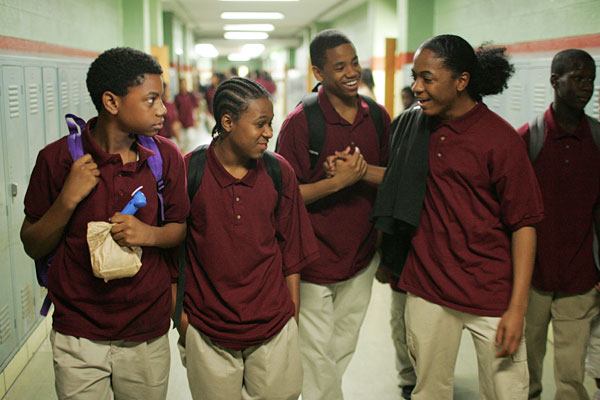
 last fall, i began my journey through the critically acclaimed scripted television series, the wire.  and i approached it like a homework assignment given to me by nearly everyone who hears me talk about the work i've been engaged in for almost fifteen years - participatory research with  adolescents living in urban contexts, court-involved and not.  so, after a rocky start - the first 3 episodes of season 1 were a shock to the system, for reasons i'll post later - i finally arrived at season 4, commmonly referred to as "the education season" in which the series regulars continue their march against corruption, the drug wars, and the ongoing bevy of crime-related activities, while a group of middle school students is introduced in the summer before they return to school as eighth graders.


prior to delving into season 4, i quickly read the first in a series of commentaries written by sudhir venkatesh, a sociologist at columbia, as he watched season 5 with "real thugs" - i only skimmed the piece because i did not want to learn too much about the last season before completing the penultimate one.  but the ethos of the series - he wrote a commentary after each episode in season 5, viewed alongside men who he had come to know through his research, particularly focused on the underground economy of the drug trade - intrigued me.  what would  it mean to watch a popular television series depiction of how the systems of education and justice intersect a little too seamlessly in the lives of middle school youth?

i've seen the first episodes in the season, thus far.  having invested three seasons in the morality, motivations, and histories of the primary characters, i find myself reading the scenes much differently than if i had started watching with this season.  this seems obvious, but also important to note given how often we - the general public - are quick to make judgments - about tv characters, passers-by, acquaintances - without knowing much about them. 

and now a confession.  there is a scene in the first episode of season 4 where a group of about 6 adolescent boys, who are patiently trying to capture a white dove in order to sell it for a profit, accost a similarly aged boy who has made a noise and scared away the bird.  as i watched the boys hurl insults about the single boy's clothing, family life, lack of money, presumed lack of utilities like running water, heat... i had to turn away. my faucet-like tear ducts were in overdrive and i had to pause the dvd momentarily and decide whether i could go on.  certainly, this would not be the worst actions depicted in the season, nor in the series thus far.  yet, the cruelty of children - regardless of their physical maturation - was the aspect that hurt me (in not entirely unexpected ways) more than others.  i suspect this is, in part, due to the fact that i have also witnessed similar discursive moments in my work with young people, and it's the one thing - the words of hurt - that continue to mystify me the most...  but also in part because of the possibility and promise that a young face holds.


baldwin's words in "my dungeon shook..." ring loudly in my head. what are the contexts we are all born into, and how do those outside of our contexts read and interpret us based on assumptions about the contexts into which we were born?

in one scene from the third episode, a former police officer experiences his first days as a teacher.  he is teaching 8th grade math and struggles to be heard, occasionally receiving the help of one student, randy, who manages to make the situation work for him - grabbing a large stack of hall passes from the teacher's desk on the first day, and quietly exiting the classroom when one girl slices another's face, causing the teacher to panic and freeze, while another, more experienced teacher, walks in and tells one of the students to call 911.  the young woman, who caused her classmate to writhe in pain as the floor becomes saturated with her blood, sits scowling against the back wall with her knees clutched up near her chest.  the boy who was the object of the verbal insults in episode one - duquan, who is called dukey - slowly approaches her and sits down next to her.  he uses a personal fan, which he found on the ground on his walk to school on the first day, to literally cool her off.


there are so many potential opportunities to point fingers in this moment: at the girl who kept taunting her classmate until she snapped; the young woman who called on violence as a means of response; the other students who encourage antagonistic behavior in their peers; the teacher who didn't have enough awareness about what was happening in the class to intercede sooner; new, un-certified teachers, who are placed in large classes with little or no teaching experience because our urban schools are in desperate need of math and science teachers; large class sizes that are not conducive for effective learning (regardless of claims that "the studies don't bear out" effectiveness of small class size)...

with a change in administration, we are sadly seeing what is amounting to "more of the same" as programs like "race to the top" and measures of accountability only serve to reify the primacy of quantifiable, discrete, and isolated skills.  the communities of practice we see in the wire are intertwined, interdependent, situated, and contextual; tethered to local and global discourses, and yet like the kids on the screen, youth across the country continue to be reduced to statistics: % of students eligible for free and reduced lunch; # of dropouts and truants; reading grade levels; state assessment percentiles...

who is really benefiting from all of these "changes"?

12.30.2009

images of youth - the year behind, the year ahead

we live in a moment of unparalleled communicative accessibility and information dissemination. youth, so often the object of maligned commentary and political concern, are leading the charge in new modes of expression, purposes for communication, and representations of self.  yet, all too often, the stories we see in the popular press about young people are ones that highlight the exceptions and not the norm.  that is, we see reported several instances of youth using social networking to plan mass chaos and ultimately inflict harm on others.  yes, this does happen and yes we hear about it.  but how often do we hear about the use of media and technologies by youth to engage in social action?  for inspiring stories, see below:

A positive face of youth in the media - Today's Youth-Led Media Summit brings together enthusiastic young people from around the UK who want to determine their future role – and dispel the image of dangerous hoodies

Youth Radio - Youth Radio was founded in 1990 on the deeply held belief that underserved youth, ages 14-24 years old, have the creativity, technical skills and entrepreneurial spirit to become leaders in the multi-media industry and the community and to serve as mentors to other youth.

new book about harlem, youth, and multimodal literacy - In her new book, Valerie Kinloch investigates how the lives and literacies of youth in New York City’s historic Harlem are affected by public attempts to gentrify the community.  Kinloch engages the perspectives of two young men who use documentary and video making to guide their collaborative inquiry.

Adobe Youth Voices/ Listen Up! in India - In November the Listen Up! team traveled to India with our Adobe Youth Voices partners to to work with teachers and students in documentary and animation filmmaking.

America's Youth Speak Out - America's Youth Speak Out is the only youth produced national public service campaign. More than 4000 young people across the country are producing public service messages dealing with issues that are important in their lives and communities.

Youth video conference highlight: The Choose to Be the Change youth video project highlighted the Northern Ontario First Nations Communications Conference


what i hope for in the year to come are what michelle fine has referred to as "audiences that are worthy" - an interpretive context for the words, images, stories, and storying by youth that embraces a generous and generative posture.  having worked with youth to produce numerous of varied artifacts in which young people make themselves vulnerable, i am particularly committed to seeking, finding, and creating meaningful audiences for the narrative insights embodied by these artifacts.  may 2010 be the year to start/continue this work more effectively...

...

11.03.2009

new book about harlem, youth, and multimodal literacy


Harlem on our minds: Place, race, and the literacies of urban youth
by Valerie Kinloch
Teachers College Press, 2009

Discourses of youth, gentrification, place, space, and literacies converge beautifully in this volume, collaboratively constructed by Valerie Kinloch and youth researchers, who explored changes going on in Harlem through a variety of modes, discursive interactions, and ongoing inquiry.

Definitely explore and purchase for your own reading, or to read with youth, undergraduate and graduate students interested the complicated intersections of identity, place, power, and narrative discussed in this book.


From the publisher:
In her new book, Valerie Kinloch investigates how the lives and literacies of youth in New York City’s historic Harlem are affected by public attempts to gentrify the community. Kinloch draws connections between race, place, and students’ literate identity through collaborative interviews between youth, teachers, longtime black residents, and their new white neighbors. Harlem on Our Minds is a participatory action narrative that makes emerging theories of social ecology real for the high-school English classroom. Vividly drawn lessons show how teachers can engage urban youth in school-based literacy, by linking canonical text, particularly of the Harlem renaissance, to current events. Centered on the literacy stories of two African American youth and their peers, this book for our times:
  • Showcases the multimodal literacy practices of urban youth through photos, writing samples, student-designed research projects, and more.
  • Weaves in multiple voices and perspectives through response pieces by project participants, local teachers, graduate students, and a community activist.
  • Features teaching strategies and reflection points in each chapter.

10.25.2009

digital media and learning conference - call for papers, deadline: 10.30.2009

DML: First Annual Digital Media and Learning Conference
Conference Theme: "Diversifying Participation"
Call for papers - Deadline: October 30, 2009


Conference Committee: Henry Jenkins, David Theo Goldberg, Heather Horst, Mimi Ito, Jabari Mahiri and Holly Willis

Keynote speakers: Sonia Livingstone and S. Craig Watkins

(from the call)

DIVERSIFYING PARTICIPATION
A growing body of research has identified how young people's digital media use is tied to basic social and cultural competencies needed for full participation in contemporary society. We continue to develop an understanding of the impact of these experiences on learning, civic engagement, professional development, and ethical comprehension of the digital world.

Yet research has also suggested that young people's forms of participation with new media are incredibly diverse, and that risks, opportunities, and competencies are spread unevenly across the social and cultural landscape. Young people have differential access to online experiences, practices, and tools and this has a consequence in their developing sense of their own identities and their place in the world. In some cases, different forms of participation and access correspond with familiar cultural and social divides. In other cases, however, new media have introduced novel and unexpected kinds of social differences, subcultures, and identities.

It is far too simple to talk about this in terms of binaries such as "information haves and have nots" or "digital divides". There are many different kinds of obstacles to full participation, many different degrees of access to information, technologies, and online communities, and many different ways of processing those experiences. Participatory cultures surrounding digital media are characterized by a diversity that does not track automatically to high and low access or more or less sophisticated use. Rather, multiple forms of expertise, connoisseurship, identity, and practice are proliferating in online worlds, with complicated relationships to pre-existing categories such as socioeconomic status, gender, nationality, race, or ethnicity.

We encourage sessions that describe, document, and critically analyze different forms of participation and how they relate to various forms of social and cultural capital. We are interested in accounts of the challenges and obstacles which block or inhibit engagement to different forms of online participation. We also encourage session proposals that engage with successful intervention strategies and pedagogical processes enabling once marginalized groups to more fully exploit the opportunities for learning with digital media. Conversely, we are interested in hearing more about how marginal and subcultural communities find diverse uses of new and emerging technologies, pushing them in new directions and navigating a complicated relationship with "mainstream" forms of participation. Specifically, we seek to understand the following:
  • What can research on more diverse communities contribute to our understanding of the learning ecologies surrounding new media?
  • What are the technologies, practices, economic, and cultural divides that lead to segregation, "gated" information communities, and differential access?
  • When and how do diversity and differentiation in participation promote social and cultural benefits and opportunities, and when do they create schisms that are less equitable or productive?
  • What strategies have proven successful at broadening opportunities for participation, overcoming the many different kinds of segregation or exclusion which impact the online world, and empowering more diverse presences throughout cyberspace?
  • Are there things occurring on the margins of the existing digital culture that might valuably be incorporated into more mainstream practices?
In addition to these questions directly addressing the conference theme, we welcome submissions that address innovative new directions in research and practice relating to digital media and participatory learning.

Read more on conference website.

.

10.03.2009

bar code art

taking something meant to be invisible or what goes unnoticed and repurposing it by (re)imagining it as a modality for creating art. fantastic!

9.29.2009

trolling the web... a text rendering of cme09 haps.

i've been reading posts and tweets from members of this fall's culture, media, and ed class and thought i'd do a virtual text rendering - a collection of phrases that stood out to me, in no particular order:


But what about the stereotyping?
the therapy of production is part of the intangible value that comes out of that work/process of creation
I also want to spend a moment defending teachers
this wondering just led me to go to twitter ... and be met with my school's filter/firewall.
I think I’m in between phase I “Honeymoon” and phase 2 “What am I doing?”
Globalization is irreversible and nobody is in charge of it.
Abt ten min into watching the video, The Day My God Died, a mascara commercial popped up
Holy Twitter Batman! Kanye went there!?!
connected/disconnected, isolated/related, and openheartedness/a bunch of lies
structured through styles and voice long forgotten
Suddenly, I began to miss Nankai...
Who says texting has to be the enemy of the 21st century teacher?
how young people who have no role models in their lives use figures in the media as role models
loooved fam guy. cleveland show... not so much
Crowd Sourcing: Internet as democratizer or impersonator.
Now I know why IronChef can run right after knowing the secret ingredient
i need a hug.

good stuff happening in cme this semester.  makes me think more about the collective work we're trying to do, especially with this year's focus on social issue media.  in other words, what stories are we trying to tell?  who are we storying with? who are we storying for? and about?

...

9.07.2009

pres. obama's speech to kids - full text

the white house released president obama's prepared remarks that he will deliver to schoolchildren on tuesday.

at first blush, this is very much on the order of obama's campaign speeches or more recent statements about education, in which he urges a collective sense of individual responsibility, and strives to ignite fires of innovation in his listeners. but there are some important distinctions that stand out, like the reference to specific pop culture artifacts and texts, perhaps to resonate with his intended audience:
e.g., "I’ve talked about your parents’ responsibility for making sure you stay on track, and get your homework done, and don’t spend every waking hour in front of the TV or with that Xbox."
and
"Maybe you could be an innovator or an inventor – maybe even good enough to come up with the next iPhone or a new medicine or vaccine – but you might not know it until you do a project for your science class."

and he weaves his own narrative through this address, not to deliver an unexamined "bootstraps" message, but rather to illuminate the ways in which his individual determination and educational success was mediated and informed by the communities through which he traversed. the personal narrative is a tale of many cities...

i hope teachers and families not only share this speech with school-age children in their charge, but they engage with it critically. perhaps they'll wordle it, like @librarybeth has done here. or maybe they'll hold a debate to argue against or for some of the subtler points embedded throughout. i hope we engage with that which we find unfamiliar, if for no other reason than to be able to identify what it is that bothers us. but perhaps in that journey, we find things that we can agree on and we move forward. together.

...