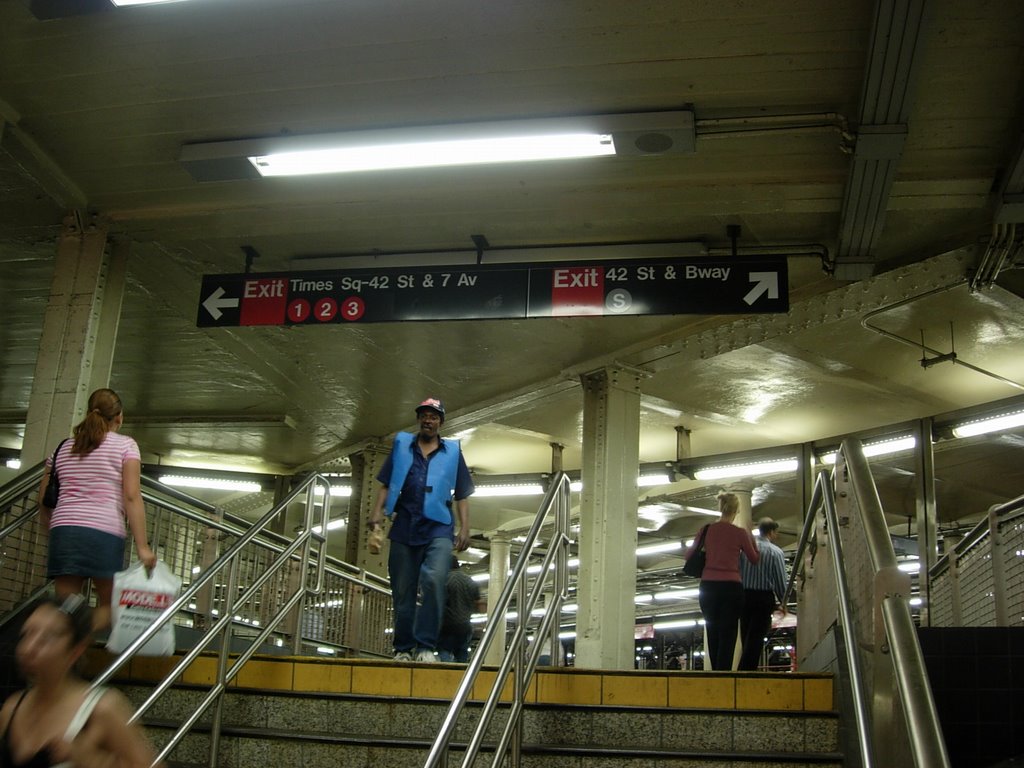
9.21.2006

inside voices


all around me, everywhere i go these days, people are exhibiting behaviors that are reminiscent of the lessons some of us learned about how to behave or perform ourselves in different contexts. though, truth be told, my immigrant upbringing didn't offer such options; i was told to "be good" no matter what the situation and was left to figure out which behaviors fell into that command, and which would earn me a stern talking-to from either of my parents, an acknowledgement of my transgression from an uncle or aunt, or, on the rare occasion, a look of disapproval from my grandmother. but i digress...

this afternoon, as i was listening to the soothing sounds of metallica's version of "whiskey in the jar" while climbing away on the elliptical machine at the gym, i was prompted to look up from my new yorker when a visual cacophony of gesturing became apparent in my peripheral vision. a young women, whose back faced me, was striding away on her arc trainer and she was approached by another woman whose face bore an earnest yet quizzical expression. i couldn't hear the exchange over james hetfield's dulcet tones crooning repetitions of "musha-rig-dum-a-do-rum-a-da" (or "musha ring dumma do damma da," depending on where you look), so i had to rely on their gestures and my interpretive abilities to make sense of the situation. it went a little something like this:
quizzical woman: motions to the arc trainer, smiles sheepishly, looks down, looks quickly back up, shrugs her shoulders, keeps smiling as she mouths something

strider: turns to face QW, keeps striding (or arc training - im still trying to figure out the new machines!), points to the machine that she is on, motions with her hand toward the doorway that leads to the upper levels, shrugs her shoulders

qw: nods, points in the direction of the doorway, shuffles her feet a bit, smiles and mouths a noticeable "thank you," walks toward the doorway

strider: returns her attention to the in style magazine opened in front of her and pauses on a layout featuring a variety of purses, continues to stride
at the end of this exchange, i found myself annoyed at the young woman who kept on striding. i read her like i read two other young women who i assumed to be freshman given their gym-wear and knowing-while-at-the-same-time-clueless attitudes. in this moment of (forced) observation, i found myself taking sides in the unfolding gym drama. but what if i had it all wrong? suppose the quizzical woman wasn't quizzical at all; instead, she was a nuisance who was trying the patience of a fellow gym patron. and perhaps the young woman in coordinated workout gear geniunely misread the time allotment sheet.

as i read elizabeth kolpert's commentary in the talk of the town section of this week's new yorker, i saw myself in her criticism of the bush administration's false optimism. she writes
"President Bush likes to portray himself as a man of unwavering optimism. ... Of all the many ingenious American things this President is optimistic about, technology is supposedly near the top of the list. ... [T]he technologies he supports are either those whihc were developed in the past - coal mining and oil drilling - or those which lie securely in the future: cars and buses that zip around on hydrogen."
she concludes the piece by noting:
"This is not the record of a technological optimist, of someone who believes in the 'ingenuity of the American people.' This is the record of a pessimist." (p.62) (see more here)
i was reading this commentary as i passively participated in the moment described above and as the moment passed and i resumed reading, i found myself wondering about the lines we draw between our theoretical frameworks and the way we write ourselves into the world. do i not have an optimistic perspective when seeking to understand how young people are making their way in the world - and interested in their innovations, and generally willing to give them the benefit of the doubt? so what was at play this afternoon? does my definition of youth or adolescent stop before college? not include students attending an elite private institution of higher education?

or maybe i just have a healthy skepticism of overly coordinated gym-goers. to whom this may apply, consider this fair warning for any and all theoretical framework transgressions i may commit heretofore...

9.18.2006

knowing your audience

(image taken from No Child, a youth documentary noted below)

last night, while channel surfing, i saw an ad in which a young, african american man was talking to an african american woman who appeared to be his mother or caregiver. he was reassuring her by saying that he has his future under control, and she returned his confident look with a smile. at the end of the ad there appeared the url: www.boostup.org and a voiceover inviting the viewer to check out the website. then i saw it. small, but not too small, an icon, the unmistakeable star that signifies the us army.

upon visiting the site, a brief message about school appears on the screen as the flash site loads. statements that encourage the website visitor to stay in school by noting that staying school earns the respect of one's family; by providing provide statistics about high school dropouts' earning power; and suggesting the availability of choices that come from staying in school. the message of staying in school is reinforced when the site fully loads with the phrase, "Inside every one of us is a graduate" written in orange that sits to the right while images of black and brown male youth, up close tags, and high school hallways lined with lockers cycle through. below this rotating image gallery are three navigation options (several more navigation links at the top of the screen, as well), one of which invites the visitor to become a storyteller: "Tell us your story." other commercials, such as the one that just flashed on my tv screen, also feature minority youth either talking to adults to straight into the camera...

i'm reminded of a film that was featured in this year's Media That Matters film festival titled, "No Child" - a documentary that looks at the military's recruitment tactics. (choose film #16)

9.15.2006

writing that does work in the world

"Girls, Social Class, and Literacy is a compelling and provocative look at the debilitating effects of classism on young girls, as well as a pragmatic and powerful examination of the transformative effects of sensitive, smart teaching on children whose lives and education are too often a reflection of their economic status. Stephanie Jones shares the insights of a five-year study that followed eight working-poor girls, offering you unusually sharp insight into what it’s like to be underprivileged in America. With critical literacy as her tool, Jones then helps you peel back your ideas of the poor—and of your own students—to see them, and your role in their lives, more clearly. Just as important, using reading and writing workshop as an instructional framework, she describes how to validate and honor all students’ realities while cultivating crucial critical literacy skills. You’ll find out why giving children the option to find and talk openly about disconnections with children’s literature (as well as connections) and to write on topics of their choosing (even difficult ones) can have a large, positive impact on students as they speak and write about their reality without shame or fear of judgment."


"Working in many genres and touching on many themes and issues, June Jordan was a powerful force in American literature. This biography reveals the woman, the writer, the speaker, the poet, the activist, the leader, and the educator in all her complexity. ... [Valerie] Kinloch offers a life and letters of this prolific writer, delving into both her biography and her contributions as a writer and activist. This approach unveils the power of language in Jordan's poems, essays, speeches, books--and ultimately in her own life--as she challenged political systems of injustice, racism, and sexism. Kinloch examines questions surrounding the pain of writing, the anger of oppression, and the struggle of African American women to assert their voices."

yet another interesting blog

just found this blog called Digital Video Guru, which appears to be about all things digital video-related. i was intrigued by one of their recents posts in which they ask: just who are you, and what do you want from us?

the entry begins:
Just who are you, anyway? Digital video is a burgeoning field involving many different professions, skills, outlets, etc. And it would help if we here at DVGuru got to know just who we are writing for, to help give us a stronger sense of direction. Are you an independent filmmaker? A camcorder hobbyist? A YouTube fanatic? An industry analyst? An editor? Cinematographer? Tech-head?

read more...

9.14.2006

apples and trees

*
the saying goes, “the apple doesn’t fall far from the tree” – an idiom evoking an understanding between the user and interpreter of the phrase. visuals always help me, so i imagined the visual that emerges when one mentally illustrates this idiom. there is a tree, an apple tree presumably; the tree flowers, and then grows fruit – some hanging lower to the ground than others; apple trees bear fruit in the fall, some of which are picked by eager visitors to apple orchards with their intentions explicit and children in tow. i was such a visitor on several occasions, when my parents took me to an orchard near my childhood home. it was on one of these trips when, at the age of 6 or 7, i first learned the word “bushel” as we picked and purchased several bushels of apples… even if we assume that somewhere, where trees are not picked clean, the occasional apple falls…is buried by the earth…grows roots and sprouts a new tree, the apple and the subsequent tree, though not far in distance, may be quite far in similarity from the tree of origin given climate changes, precipitation oddities, disruptions in soil conditions, and a whole host of other external factors. in addition, these and other factors may impact the internal chemistry of the apple, the new tree and subsequent apple. physically, the tree may stand in the shadows of it’s seed bearer, but metaphorically it may be worlds apart.

at the end of a recent episode of “30 days,” in which morgan spurlock spent nearly a month in a minimum security jail, updates are given for some of the inmates who figure prominently in the episode. both men are remanded within weeks of their release. these updates could be seen to underscore the musings spurlock shares via his video diary about the need for rehabilitative programs and the indelible effects of punishment-oriented practices; or the data given could lead the viewer to a deepened conviction about arrests and incarceration. when the lives of court-involved youth are on the line – and, when corrections education programs stand as an intervening space of second chances and new educational and life possibilities– the idiom must be questioned, for so much of juvenile justice research and related policy is grounded in statistical probability regarding arrest and incarceration. patterns can be made to exist when questions remain stagnant and methodology staid. thus, a new challenge arises: how do we recognize the relationships between apples and trees, without constraining or overextending their reach; and how do we make room for crabapples and pluots?

*image taken from freakonomics cover

9.12.2006

the internet is... a space of/for parodies

case in point: my cubicle.

enjoy (the video as well as the comments that follow)

alter-news

while following a link to a news story about the effects of gun violence on youth (see below), i was introduced to New America Media.
from their website: "New America Media is the country’s first and largest national collaboration of ethnic news organizations. ... NAM’s goal is to promote the editorial visibility and economic viability of this critical sector of American journalism as a way to build inclusive public discourse in our increasingly diverse, global society. NAM produces and aggregates editorial content from and for the ethnic media sector and develops pioneering marketing services on behalf of corporations, foundations, and non-profits who are targeting ethnic media and ethnic communities." for more, click here
the article mentioned above is titled "Got Shot: The Series" - a four part multimedia feature that looks at the effects of gun violence on bay area (san fran, ca) youth through commentary, analysis, and description in the form of words and documentary footage. in addition to featuring youth as central sources, the feature was produced by youth media producers. the feature - and i keep using that word b/c article doesn't quite capture it, and document feels reductive - is inspiring in both form and content; frustrating for what is being shared and how few may hear and see it.

check it out and pass it on.

9.03.2006

happy new year!


in addition to the uncanny ability of youtubers to make available most of what i seek audiovisually these days, another one of my favorite things is the start of a new academic year. perhaps being a virgo with an early september birthday triggered some kind of defense mechanism or survival tactic in me wherein i turned an inherent grossity - my birthday signaled the start of a new school year - into something positive: i was the kid who brought in popsicles and ice cream cakes to school in recognition of birthday and thereby extending summer ever so slightly, while others usually stuck with more traditional baked birthday treats. whatever the reason, i absolutely love the sights, sounds, and smells of a new school year.

more recently, this time of year - of not quite autumn and no longer summer vacation - has taken on new meanings, particularly with the start of new jobs and with them new identities and responsibilities... for the past fourteen septembers, i have been on a university campus and this year, like many before, a sidewalk poster sale outside of the campus book store from where i am writing this post that continues it's yearly tradition of making available a range of multimodal artifacts that incoming freshman - and some late-blooming upper classmen - can use to decorate, make statements, establish friendships and make like home their new surroundings.

six young men huddle around one display to determine exactly which humorous beer poster to hang in their living room; three young women, each clutching a poster bearing a different feminist saying, roll their eyes as they pass their male counterparts deep in beer thought; three other young women contemplate finances to decide who will purchase the wall tapestry and who will buy the movie posters they have settled on; and at least two-thirds of the hundred or so undergraduate students gathered along the 50 feet of posters and various other trinketry make themselves known via tee shirts with words emblazoned across their chests such as "cute and unattached" "cuz i like it that way" "yugo" "tommy hilfiger" "class of 2010" and on and on.

and there are packs everywhere - the traditional freshman pack of no less than 7, and often 10, new students clustered together as they move from book store to coffee shop and back to book store to attend the new student orientation ice cream social. a band has been hired, food and drink is provided, and the university is doing what it can to make these new students and their families feel welcome. the year is full of promise - academic, social, and otherwise.

i'm not one to make new year's resolutions - unless made to do so for a writing assignment in 4th and 5th grade - but i do make new school year resolutions. the promise and energy is contagious, and as much as i enjoy the restorative potential of summers, the new school years offers a chance for reinvention and new ventures. i'm still working on this year's resolutions, but i know any list i concoct will most definitely include finally sending out that article i've been tinkering away at for twenty-two months and finding a decent indian restaurant in new york city (to be fair, i've only eaten at one in the past two years - l'il help??)...

happy new year!

9.01.2006

writing by hand


i received a thank you note in the mail today. it was handwritten. from the slant of the script on the envelope i instantly knew the identity of the sender, and the contents did not disappoint. inside were details, descriptions, and anecdotes that covered nearly all available blank space with the familiar script. the smile on my face remained for the duration of my reading and then rereading to be sure that i hadn't missed anything.

earlier today, while continuing a month-long conversation with a group students about the school-to-prison pipeline, i watched more writing happen. it's been some time since i took the time to watch people write - i indulged in the luxury of having someone else present who was taking fieldnotes - and in this indulgent space of close observation i became taken, once again, with the posture, breath, and sensuous of hand writing.

hands gracing sheets of paper, fingers caressing pencils and pens, eyes looking upward, then close to the table, and at once looking nowhere in particular. deep inhales and measured exhales. outward performance of an intimate conversation with oneself - the nods, rubbing the foreheads, hands on the side/back/top of the head. doing and undoing ponytails.

and laughter. as one person reads the note another has passed him. furtive glances full of guilt, immediately replaced with grins upon realizing that laughter is not out of place in this space, today, of scripting texts by hand.

i'm not usually one to feel nostalgic about the practice of putting pen/cil to paper - not as i try to live as paperless an existence as i can, edited books notwithstanding... - however, as i collected the latest revisions which built upon, extended, and reworked the previous hand-writing the students had done, i found myself handling the sheets of lined paper full of their words with the greatest care, letting my fingers linger over certain clusters of letters, most of which were written in pencil. almost at once i worried about the short lifespan of words penned in pencil and made a mental to scan the sheets when i got back to my office.

8.24.2006

why?

is this the best way we can think of to use the space of television in the year 2006?

8.22.2006

wondering...

what we exactly mean by adolescent literacies...

it's a thought/musing/dilemma that has arisen in a few pieces that i'm wrestling with at the moment, and among the questions that arise are:

which adolescents?
practices only?
(in what ways) are literacies spaces?
what happens when the literacies practices by adolescents are practiced by non-adolescents?
what are the bounds by which we discuss and delineate the literacies in the lives of adolescents?
how do we understand practices that exist outside of those bounds?

in the words of one young man who is no longer attending school and is enrolled in a court mandated GED program: [paraphrasing] the only time teachers or anyone says anything to us is to tell us we're doing something wrong.

where do we locate research about "new" literacies?

another young man in the same class uses his ipod nano to play solitaire - b/c it's helps him concentrate, and he wants to see how good he can get at it - while engaged in a social studies focused class discussion/lesson about social systems and forms of government.

my questions stem from the tension surrounding the dichotomizing of old/new literacies; digital/analog systems; and access/no-access to technologies. what questions do we investigate about the evolving landscape of literacies as it is played out in the lives of youth about whom little is written in the way of new literacies? writing, like that of of steve goodman and jabari mahiri, offers images of urban and inner city youth engaged in innovation, creativity, and discovery related to literacies and broader communicative practices. in doing so, they, and others, push our conceptions of where new literacies live, are embodied, and from where they emerge and are born. yet, so many of the questions we ask about new literacies don't seem to be situated in contexts determined to be technology-poor... and when literacies research is located in city contexts, there is often an underlying desire to prove existing deficit assumptions wrong. in doing so, do we not reify these assumptions? in spending time and word count on how/why something isn't, we lose space to tell what is and how... i've been a perpetrator of these practices myself, especially because i believe that dispelling erroneous assumptions can help to unravel some of the destructive practices that are currently in place in contexts where urban adolescents spend their time. but i find myself more and more wondering, and taking on the challenge of, describing "what is and how" - not as a counterpoint or counterstory, but as a story unto itself.

innovation as innovation.

and everyone is literate.

8.17.2006

water falls, human flaws...


i fall. a lot. and often, this happens as i am either descending or ascending stairs. so i guess subconsciously i don't want to waste a fall on just any old flat surface. if i'm going to fall, it's going to count. that's also perhaps why i fall (a lot) in public. in public and at the mercy of strangers. strangers who, without fail, have been kind, have helped me up, and have let their gaze linger long enough to be sure that my hobble evened out into a steady walk. such an occurrence happened this evening as i was switching from the r-train - after an obscene and fruitless wait for the n- or q-train at the canal street stop - to the 2-train. i was ascending the stairs from the r when, two steps from the landing, i slipped - apparently on concrete! - and all at once banged my right toe/knee/elbow/other elbow/other knee. i only know this because of what hurt afterwards, and based on these injuries, can only imagine what a graceless mess i must have looked like. it probably didn't help the scene as i popped back up and it was a few seconds before i realized that a kind man was steadying me by laying a hand under my right forearm.

he asked me, "are you all right? you sure?" and i nodded, hurriedly, muttering, "thank you, thanks so much." and, in an almost paternal way he, who didn't appear to be much older than i am, encouraged me to "slow down, take it slow." but it wasn't in the condescending way people tend to tell each other to "slow down!" when they themselves are rushing and being a hazard to the entire free - and i use that word lightly in these odd times - world. it was more in the tone of one person reminding another that sometimes, you have to take it slow.

this relatively short moment in time caused me to spend the rest of my journey homeward in a reflective state and i focused primarily on the two hours i spent listening to presentations made by students enrolled in a career skills class in an alternative school where i do fieldwork for one of my research projects. the topics covered ranged widely: welfare, immigration, hip hop violence, corporate hustling, gay teens, black on black crime, and others... in attendance was the class, several other teachers and case managers, and a handful of students who participate in other classes throughout the program. it was an event marked with thoughtful critique, a spirited question/answer session following each presentation, and the courage to research and discuss complicated subject matter.

as i fell and stood up again, i thought about the presentations i had listened to and recognized that while falling is embarrassing, and while there will be people who laugh, there will also be people who will help you up. i thought about the alternative education programs i've been a part of over the last decade. corrections education certainly isn’t perfect, but in the past year i've spent time in two that work precisely because everyone has fallen and has been given the chance to stand again. during their presentations, these fourteen young men and one young woman stood tall behind a podium as their audience listened to and engaged them. and for a few minutes each, they were experts in their topic and commanded the attention of the room. these are the moments and triumphs that mark education beyond the traditional school walls, yet all too often we hear how young people must be feared, contained, and punished.

we all fall; some falls are more public, some are more long lasting, and only some of us are given a good hand to lean on as we stand back up.

*photo courtesy of yours truly

8.13.2006

more youtube

it gives me great pleasure to know that i am not alone in my tendencies to get lost in youtube.com's links upon links upon clips upon videos...

Millions addicted to YouTube online video site

Great music moments found on YouTube.com

8.12.2006

wiki this


while engaged in my latest favorite pasttime of wikipedia-ing tv while i watch - usually shortened in my head, and sometimes in my diction to "wiki this, wiki that" - i looked up the entry for malcolm in the middle. the episode i was watching featured the mom, lois, costumed and dancing around with her mom, played by cloris leachman, in outfits that resembled the ensemble that sandra bullock wears in the scene from miss congeniality where she is playing the water glasses at a pre-pageant talent showcase. (i'm not sure i can actually count all of this information toward my love/study of "popular" culture....) anyway, moving on... i was caught by the cluster of information in the entry for MITM that focused on how the show was intentionally anonymous, similar to the mystery surrounding the geographic location of The Simpsons hometown of Springfield. this mystery has certainly captured the imaginations, and observation skills, of many of the show's viewers and some of the wikipedia entry writers. for example, they write:
- There is also a good chance that the family lives in Arizona, as in the episode "Future Malcolm" when Dewey is being reprimanded for painting on the wall, a water bottle with the symbol for the NFL team the Arizona Cardinals is clearly visible.

- Also, in episode 110, "Stock Car Races", when Hal and the boys are entering the track the billboard behind the entrance displays the place as Irwindale Speedway (a real race track in Southern California).

- (my particular favorite of the ones listed): Oklahoma is a possibility. In later seasons, license plates display "Cherokee State" which is another name for Oklahoma. Despite that, the look of the plates intentionally made like California's, such as the font of the words "Cherokee State", and digits are in the format of "1 XXX 111", where 1 is a digit, and X is a letter. In episode 415, Otto was singing the title song from "Oklahoma!." In episode 313, Oklahoma Highway Police can be seen on the police car doors. However, in one episode, Hal comes to visit Francis at military school and upon seeing his father, Francis exclaims, "you drove eight hours just to see me!" The school is known to be located in Alabama, so Malcolm's family must live within an eight-hour drive of the state, perhaps in Florida. On the other hand there is also in episode 418 where Reese is sent to Whitehorse on a bus for at least 52 hours. Malcolm: "Reese, think about it. It takes 26 hours to get to Canada, and 26 hours to get back. Your bag is filled with food and nobody called Grandma!" Only Alaska is within a 26 hour drive of Whitehorse, Canada. However, in episode 43, Alaska is stated to be "5000 miles away and in the episode "Krelborne Picnic", Francis says "So I'm still a member of the family even after you sent me away to military school 1,000 miles away". In the series finale, Malcolm reveals that Harvard is 2,000 miles away. Triangulation using these distances puts the family's location somewhere in West Texas.

...and so on. what fascinates me about this is people's (viewers') collective desire to locate information they receive - via a television program, fictional sitcom notwithstanding - within shared schemes and experiential landmarks. where do they live? where is all of this taking place? throw me a bone!!! it's even noted in the show's wikipedia entry that the family's last name is never (or maaaaybe once) mentioned.

if we continue to understand literacies as local and situated and epistemologies as informed by experience, from a research standpoint, "placing" the characters and the show would seem to be of utmost importance... situating our own "reading" of how they move through their worlds would be significant for interpreting and anlayzing what it is they are doing - e.g., arguing as a family; planning the annual practical joke; ostracizing the kid who isn't a team player; etc... from my experience, it's the desire to understand the concepts that are emic to who or what i'm observing before i can make claims about it. but what if our observational capacity is limited? what if, as more of us are exploring realms where we have limited access, limited time to acclimate, and limited understanding of what questions we should even be asking, the landscape remains anonymous? i can still say that malcolm is a quirky character who has taken on some of his "real life" actor persona, but then that would be all; and it would be based on occasional viewings of the show, coupled with an unfortunate viewing of an old episode of Punk'd, and driven by a proclivity to analyze through comparison. wikipedia might just be on to something though - thanks to the collective efforts of my fellow inquiring minds, i can now add to my analysis that anonymity was not only the ethos of the show, but also something that malcolm strived for and lived out through his little brother as he "help[s] him stay in normal classes" (instead of the "gifted" classes like he put in by his parents. ok, it's a stretch, but it's my ongoing support for collaboration in research, especially acknowledging that the construction of new and diverse spaces yields not only so many more questions, but also many more limitations on participation, access, and inquiry...

8.07.2006

reading worth reading and watching and listening


i just recently re-discovered the beat within, a weekly magazine written by incarcerated and recently incarcerated youth. the site includes writing, video diaries, and news related to juvenile justice.

(photo is part of a collection by joseph rodriguez titled "juvenile justice")

het·er·og·e·nous


at the top of my gmail, i am daily treated to random bits of news and the occasional "word of the day" from dictionary.com. today's word, heterogeneous, is particularly poignant as i think about the recent After Words episode i watched in which congressman tom tancredo (r-co) was being interviewed by anne mulkern of the denver post. you can watch the whole interview here, so i won't summarize the whole thing. however, i will share one small tidbit that has got me thinking (again) about teacher education...

tancredo was on the show to talk about (read: promote) his new book in mortal danger: the battle for america's border and security. at one point, mulkern asks him to expound on his decision to include in his book the story of a public school teacher who was expressed frustration at having to celebrate black history month - apparently, such a comment was made in the context of having to diverge from necessary curricula... tancredo, smiling and almost a little eager, responded with the even tone he'd been using the entire time and explained that he felt that the teacher's story was indicative of a larger trend where there are celebrations of all kinds happening, while "american" holidays go unrecognized. he cited veteran's day as one example of one such forgotten holiday.

i exhaled slowly as i listened to this, and watched as he tancredo shook his head in disbelief that such adultering of the "american" curriculum was going on. earlier, mulkern had asked the congressman what "american" meant to him. he gives a litany of checklist-like qualities, but it is the second that stood out to me: [paraphrasing] speaking english, or expressing a desire to and being on the path to being a proficient english speaker.

so now i think of that school teacher who expressed her woes about having to indulge the district requirement to recognize black history month. and i wonder to what extent the tenets of plurality and, yes, heterogeneity are being engaged at the moments when not-yet-teachers are developing their understandings of not only pedagogy, but the historical context in which they are purporting to participate in the act of teaching and learning. we talked a good deal in the graduate classes i took about multiculturalism, critical multiculturalism, diversity, and occasionally, race and racism. but perhaps we need to talk more explicitly about the fact that history and sociocultural context matters not only in harlem or the delta, but, in fact, everywhere. could we ignore the heterogeneous history on which all of social life was founded and is based?

but what good is any of this musing to the teacher who feels burdened by what she considers extra to the curriculum? and, more to the point of teacher ed, how do we use the very short time that teacher ed programs have with pre-service teachers (as they strive to stay competitive with the rapidly growing numbers of alternative certification programs) to move from dialogue to action around principles of plurality (which undergirds so many connected discourses - e.g., literacies, positionalities, anti-racist pedagogies...)?

8.06.2006

fears averted


when i first learned that a spoof of an inconvenient truth that had been circulating on youtube.com was really a commercially produced piece of media that was the work of a PR and lobbying firm whose client list includes Exxon Mobil, i admit, i was perturbed.

upon viewing said piece of media, however, i was reassured that commerically produced "amateur" video can't take the place of the real fake thing. case in point - check out some of the real spoofs based on gore's movie.

long live amateur video democracies!

7.31.2006

latest from all4ed

a few different articles came out recently bemoaning (once again) the "low literacy rates" and "lower reading skills" of adolescents. there are references made to students' attitude toward education, downward spiral of interest in school given difficulty with decoding print, and the recognition that "it's not just the immigrants"... and platitudes about assessments, learning, and the achievement gap that maintain the focus of blame on students and teachers, who are unprepared to teach reading in middle and high school. if these are the discourses that are dominating the growing attention being paid to adolescent literacy, where (oh, where?) is the space for new literacies?

read more from an online chat with alliance for education's jeremy ayers

7.09.2006

life is like a parfait glass full of ice cream

i loved to read as a child. it was my escape from what i understood to be a dull existence; a practice i could indulge without inviting the disciplinary actions that followed my excessive television watching; a solitary activity that filled up hours and hours and hours of time. for a class early in my master's program, i wrote a paper reflecting on my relationship with reading and detailed the distinguishable periods - e.g. american plays, teen angst, the russians, old south, new south, etc. - yet made one glaring omission: indian comic books. that's right, a collection of comics known simply as amarchitrakatha - three words slurred together to indicate the vast world of comics created for children (and presumably the occasional adult) to learn about indian history, mythology, culture and religion. i had stacks of them and to this day can recall specific frames from stories. my grandmother, who was my other primary source for all things indian mythology-related, and i would carefully go through the comics together - the only kind of book i would ever involve another person in the reading or experiencing of - and compare her version with the version in the text. often, the brief retelling found illustrated and captioned would prompt her to launch into more detailed and nuanced versions that would fill up the afternoon. her voice is often connected to story frames etched in my mind.

this evening, as i (once again) walked through the campus bookstore, i came across a text that i hadn't seen before. the title on the thin spine read "introducing cultural studies" and the image on the black, glossy cover is a cartoonesque old-time, parfait glass filled with an assortment of fruits, and colorful scoops of ice cream, and is topped of with sprinkles, a cherry, and lovely slice of pineapple. i couldn't resist, so i added it to the pile of books in my hand (including one on vegetarian grilling) and headed upstairs to the cafe. as i began to flip through the pages, that were light on text and heavy on the images, i felt a familiar sense comfort and pleasure. it wasn't that i hadn't read the work stuart hall or pierre bourdieu before, but experiencing the juxtaposition of a dialogue bubble coming out of a bourdieuian bust alongside no-frills commentary gave those earlier readings and discussions new life. it felt like the catalyst i've been wanting... and i am reveling in the form, perhaps more than the content at times - of this use of cartoon drawings, rules of comic engagement, and text that doesn't always stay within the lines. this is cultural studies that makes me laugh and think at the same time - not something i can (always) say for hall... and it's not that the issues being raised are always a laughing matter, but rather the irony that undergirds much of social life is sometimes better illustrated through the absurdity of image than pages of text. i'm only halfway through the book and will write more when i've gotten all the way through.

7.08.2006

all's quiet...

there is something about the routinized expectations of the academic year that i sorely miss when summer hits. don't get me wrong - i love staying up until 4, sleeping in until 11 and leisurely moving between writing, editing, tv watching, old movie devouring, and recipe inventing... however, this summer is oozing with expectation and anticipated-moving-to-fully-realized frustration. this is the summer where so much was supposed to happen, and now, it's half over. i fully blame my lack of meetings, classes, and office hours, which i was itching to get a break from as may rolled around. this is about more than "grass is greener" syndrome - it's a harsh realization that perhaps...maybe...routine helps us be more productive.
ok, i don't mean this in quite the cheeky way it sounds. it's just that i spend so much of my waking time arguing for reduced structures, less rigidity, and more flexibility in the education of and for youth, yet i sit here secretly - although, not so secretly anymore - craving rigidity myself. it's not as if deadlines aren't looming - they are a'plenty! - and that todo lists don't exist - they do, in triplicate! - but rather, there is a camaraderie that exists during the academic year that i feel lost without during the summer. it is perhaps why i sought out not one, but two groups of fabulous women as writing groups to support the dissertation writing process; why i get a high after talking with colleagues and attending conference presentations (albeit, while not always paying attention) and get more focused writing down in the hours following these events than when i have hours, days, weeks, even months ahead of me where little time is structured. i am a poster child for the notion that learning is social...and perhaps that social, for me, needs to be put on my calendar and be in the midst of warm black tea - either blackberry sage or a chai blend will do nicely.
i have read other colleagues blogs and public declarations that there is never not enough to write, but just not enough time to write it all. i agree. and have notebooks and word documents filled with pages of thoughts, article starts, and commentaries to prove my allegiance to these declarations. yet, here i sit, in the bookstore of my alma mater, wishing i had less time so that i could get more done.