Media That Matters
Presents
Immigrant Heritage Week 2010 Screening
Wednesday, April 21 7:30 - 10:00 pm
Maysles Cinema
343 Malcolm X Blvd/Lenox Ave
(Btwn 127th & 128th Streets)
Suggested Donation $10
Celebrate Immigrant Heritage Week 2010 with Media That Matters as we host an evening-long screening at Maysles Cinema on Wednesday, April 21 from 7:30 - 10:00 pm! In partnership with the Mayor's Office of Immigrant Affairs, Media That Matters will be showcasing films that focus on the immigrant experience, American identity and international communities. The evening will also feature Arts Engine staff facilitating discussion with guest organizations--Safe Horizon, New York Youth Leadership Council, NYU Center for Human Rights & Global Justice, Caribbean One and African Services Committee--available for questions and conversation.
Here are just a few examples of the films on the evening's lineup:
Vision Test (Wes Kim)
Who would you feel most comfortable with as the CEO of a Fortune 500 company? What begins as a routine eye exam turns into an examination of people’s subconscious attitudes towards race, gender and power.
Slip of the Tongue (Karen Lum & Youth Sounds Factory)
What's your ethnic makeup? A young man makes a pass at a beautiful stranger and gets an eye-opening schooling on race and gender.
Exiled in America (Angela Torres Camarena)
Five siblings struggle to support their American livelihoods after their mother is deported to Mexico.
Why Do White People Have Black Spots? (Anya Kandel & Momentus International)
Youth in Ghana pose questions to people outside of their borders and spark an ongoing dialogue through film.
The Next Wave (Jennifer Redfearn & Tim Metzger)
The Carteret islanders struggle to relocate as some of the world's first climate change refugees.
Please visit the Maysles Cinema website for a complete schedule and to RSVP for the night's events: Maysles Cinema Calendar <http://www.mayslesinstitute.org/cinema/calendar.html>
Also, check out Arts Engine's Media That Matters website <http://www.mediathatmattersfest.org/> for more information on our film collection, ways you can hold your own screening and how to take action on issues that matter!
We hope to see you there!
Contact: Weisi Li | weisi@artsengine.net <mailto:weisi@artsengine.net>
Arts Engine, Inc. supports, produces, and distributes independent media of consequence and promotes the use of independent media by advocates, educators and the general public.


4.15.2010
new book about adolescents and online literacies

New volume edited by Donna Alvermann
Description:
A compilation of new work that makes concrete connections between what the research literature portrays and what teachers, school librarians, and media specialists know to be the case in their own situations. The authors (educators and researchers who span three continents) focus on ways to incorporate and use the digital literacies that young people bring to school.
3.25.2010
deadline extended!!! social issue media festival
first annual teachers college social issue media festival

extended deadline: april 16th, 2010

3.10.2010
social issue media festival - call for entries
 CALLING ALL PARTICIPANTS!
Join us for the first annual Social Issue Media Festival to be held at Teachers College, Columbia University. The festival is an opportunity for you to voice your opinions on a social issue of your choice.
So what's social issue media? For the purposes of this festival, we are referring to digital, multimedia artifacts (e.g., video, audio podcast, digital story) that call attention to a social issue with the intention of evoking social action.
So how do you participate? It's pretty simple:
-Open to anyone in the Columbia University community (Students, faculty, staff, & alumni)
-Entries must be submitted by Monday, March 22, 2010
-Entries are between 2-3 minutes in length
-Entries can be dropped at 322 Thompson Hall, Teachers College and/or links can be sent to TCMediaFestival@gmail.com
All entries are eligible for jury awards.
For entry form, guidelines, and more information, please visit us at tcmediafestival.wordpress.com or email us at TCMediaFestival@gmail.com. Please forward to anyone who might be interested!
The TC Social Issue Media Festival Screening will be held on Thursday, May 6, 2010 from 4:30-6:30 pm in Milbank Chapel. A reception will follow in the Trustees Room, Zankel 125.
download flyer here
download flyer here
Multimodality and Learning Conference - 2010 - deadline extended!
Multimodality and Learning Conference: Environments, Rhetoric, Recognition, Play, and Methods
July 6th and 7th 2010
Institute of Education, London
July 6th and 7th 2010
Institute of Education, London
Extended Deadline: March 12, 2010
Aim and scope
The overall aim of the conference is to explore multimodal perspectives on learning and to open up theoretical, methodological and pedagogical questions and debate.The conference will be of interest to educational practitioners, research students,researchers and academics from a variety of disciplines including semiotics, linguistics, sociology, anthropology and design.
The overall aim of the conference is to explore multimodal perspectives on learning and to open up theoretical, methodological and pedagogical questions and debate.The conference will be of interest to educational practitioners, research students,researchers and academics from a variety of disciplines including semiotics, linguistics, sociology, anthropology and design.
Complete conference details here: https://sites.google.com/a/lkl.ac.uk/cmr/conference-july-2010
2.07.2010
On the meanings of writing and publication
"publication is the auction of the mind of man"
What do we do when we "publish our research"? What does the act of publication mean for those of us who call ourselves researchers, whose identities are wrapped up in the business and art of storying the lives of others (and perhaps by proxy, ourselves)? When we move from initial notations of our observations to narrative accounts of "what happened" or "who someone is"? How might we compose with intentional fluidity and fluid intentionality? Whose lives are auctioned when we publish? And with the possibility of collateral damage, what are the possibilities for...what? What do we gain when we publish? Do we distribute knowledge? Further reify or discursively disrupt?
During a recent seminar discussion with colleagues, while discussing texts - whose forms locate them on the margins of my daily readings, yet whose meanings are familiar - we considered the distinction between "writing as reporting" and "writing as enacted inquiry". What vulnerabilities do we risk when we step aside from a 'disembodied voice of authority' to reveal our own discursive hesitations? Is there an audience for writing that reveals rather than merely reports? Writing that seeks to educate through invitation rather than obfuscation?
Dickinson's words haunt me, but so, too, do they keep me alert - alert to the ways I put pen on paper, fingers on keyboard to produce words that claim to tell a story about the multi-storied lives of the young men and women who share their stories with me. Where does that leave the ethnographer: as a storyteller? Storymaker? Storybreaker? Are we making meaning? Constructing knowledge(s)? Representing our ways of knowing?
Within the frame of publication, therefore, can we imagine or move toward publication that does not cause us to sell our souls? (or to recall, with chagrin, the sins of our (publishing) infancy?) What is it to publish, to make public, particularly from within the university? At times, it feels like a dance performed ever-so-delicately through norms and assumptions, skeptics and critics, our communities and naysayers, with the goal of remaining standing long enough to learn another step. Do we risk paralysis in our writing when we focus on publication?
2.02.2010
1.30.2010
CFP: Visual Interpretations conference at MIT
humanities + digital conference 2010
"Visual Interpretations" - Aesthetics, Methods, and Critiques
Of Information Visualization in the Humanities, Arts, and Social Sciences
May 20-22, 2010 at Massachusetts Institute of Technology/HyperStudio
http://hyperstudio.mit.edu/h-digital/
How do visual representations of complex data help humanities scholars ask new questions? How does visual rhetoric shape the way we relate to documents and artifacts?
And, can we recompose the field of digital humanities to integrate more dynamic analytical methods into humanities research?
HyperStudio’s Visual Interpretations conference will bring digital practitioners and humanities scholars together with experts in art and design to consider the past, present, and future of visual epistemology in digital humanities. The goal is to get beyond the notion that information exists independently of visual presentation, and to rethink visualization as an integrated analytical method in humanities scholarship. By fostering dialogue and critical engagement, this conference aims to explore new ways to design data and metadata structures so that their visual embodiments function as "humanities tools in digital environments.” (Johanna Drucker)
We welcome submissions from practitioners and theorists of digital humanities as well as such connected disciplines as art, design, visual culture, museum studies, and computer science.
Topics include:
· Expressive and artistic dimensions of visualizations
· Subjectivity and objectivity in information visualization
· Dynamic/multidimensional visualizations and user collaboration
· Social media and contextualized visualization
· Cultural history of visual epistemology
· Limits and affordances of the translation from data to visualization
· 2D and 3D visualizations of historical/social/political data
· Visualization across media and the archive
· Digital visual literacy & accessibility
· Relationships between database and interface
· Alternative modes of data representation.
Submissions:
We are inviting submissions for the following conference formats:
· Papers with 15 minutes of presentation and short discussions (12 slots)
· Short presentations, so called “6/4s” with 6 minutes of presentation and 4 minutes of discussion (18 slots available)
· Mini-Workshops, 30 minutes each (6 slots)
· Demos and Posters (30 slots)
Deadline for submissions: March 31, 2010
Organizers:
MIT HyperStudio for Digital Humanities (http://hyperstudio.mit.edu)
MIT Communications Forum (http://web.mit.edu/comm-forum/)
For more information: http://hyperstudio.mit.edu/h-digital/ or contact: h.digital@mit.edu
http://hyperstudio.mit.edu/h-digital/
How do visual representations of complex data help humanities scholars ask new questions? How does visual rhetoric shape the way we relate to documents and artifacts?
And, can we recompose the field of digital humanities to integrate more dynamic analytical methods into humanities research?
HyperStudio’s Visual Interpretations conference will bring digital practitioners and humanities scholars together with experts in art and design to consider the past, present, and future of visual epistemology in digital humanities. The goal is to get beyond the notion that information exists independently of visual presentation, and to rethink visualization as an integrated analytical method in humanities scholarship. By fostering dialogue and critical engagement, this conference aims to explore new ways to design data and metadata structures so that their visual embodiments function as "humanities tools in digital environments.” (Johanna Drucker)
We welcome submissions from practitioners and theorists of digital humanities as well as such connected disciplines as art, design, visual culture, museum studies, and computer science.
Topics include:
· Expressive and artistic dimensions of visualizations
· Subjectivity and objectivity in information visualization
· Dynamic/multidimensional visualizations and user collaboration
· Social media and contextualized visualization
· Cultural history of visual epistemology
· Limits and affordances of the translation from data to visualization
· 2D and 3D visualizations of historical/social/political data
· Visualization across media and the archive
· Digital visual literacy & accessibility
· Relationships between database and interface
· Alternative modes of data representation.
Submissions:
We are inviting submissions for the following conference formats:
· Papers with 15 minutes of presentation and short discussions (12 slots)
· Short presentations, so called “6/4s” with 6 minutes of presentation and 4 minutes of discussion (18 slots available)
· Mini-Workshops, 30 minutes each (6 slots)
· Demos and Posters (30 slots)
Deadline for submissions: March 31, 2010
Organizers:
MIT HyperStudio for Digital Humanities (http://hyperstudio.mit.edu)
MIT Communications Forum (http://web.mit.edu/comm-forum/)
For more information: http://hyperstudio.mit.edu/h-digital/ or contact: h.digital@mit.edu
1.18.2010
time magazine explores the diversity of youth through image
 photo book: american youth - A fascinating new collection of photographs explores the extraordinary world between college and adulthood. By the photographers of Redux
teens in america: class pictures - In an extraordinary new book, photographer Dawoud Bey photographs and talks with American teenagers, creating a diverse group portrait of a generation that defies our expectations. Each photo is accompanied by a short caption in the voice of each teen in the portraits.


1.06.2010
the wire - season 4. musings, part 1
last fall, i began my journey through the critically acclaimed scripted television series, the wire. and i approached it like a homework assignment given to me by nearly everyone who hears me talk about the work i've been engaged in for almost fifteen years - participatory research with adolescents living in urban contexts, court-involved and not. so, after a rocky start - the first 3 episodes of season 1 were a shock to the system, for reasons i'll post later - i finally arrived at season 4, commmonly referred to as "the education season" in which the series regulars continue their march against corruption, the drug wars, and the ongoing bevy of crime-related activities, while a group of middle school students is introduced in the summer before they return to school as eighth graders.

prior to delving into season 4, i quickly read the first in a series of commentaries written by sudhir venkatesh, a sociologist at columbia, as he watched season 5 with "real thugs" - i only skimmed the piece because i did not want to learn too much about the last season before completing the penultimate one. but the ethos of the series - he wrote a commentary after each episode in season 5, viewed alongside men who he had come to know through his research, particularly focused on the underground economy of the drug trade - intrigued me. what would it mean to watch a popular television series depiction of how the systems of education and justice intersect a little too seamlessly in the lives of middle school youth?
i've seen the first episodes in the season, thus far. having invested three seasons in the morality, motivations, and histories of the primary characters, i find myself reading the scenes much differently than if i had started watching with this season. this seems obvious, but also important to note given how often we - the general public - are quick to make judgments - about tv characters, passers-by, acquaintances - without knowing much about them.
and now a confession. there is a scene in the first episode of season 4 where a group of about 6 adolescent boys, who are patiently trying to capture a white dove in order to sell it for a profit, accost a similarly aged boy who has made a noise and scared away the bird. as i watched the boys hurl insults about the single boy's clothing, family life, lack of money, presumed lack of utilities like running water, heat... i had to turn away. my faucet-like tear ducts were in overdrive and i had to pause the dvd momentarily and decide whether i could go on. certainly, this would not be the worst actions depicted in the season, nor in the series thus far. yet, the cruelty of children - regardless of their physical maturation - was the aspect that hurt me (in not entirely unexpected ways) more than others. i suspect this is, in part, due to the fact that i have also witnessed similar discursive moments in my work with young people, and it's the one thing - the words of hurt - that continue to mystify me the most... but also in part because of the possibility and promise that a young face holds.

baldwin's words in "my dungeon shook..." ring loudly in my head. what are the contexts we are all born into, and how do those outside of our contexts read and interpret us based on assumptions about the contexts into which we were born?
in one scene from the third episode, a former police officer experiences his first days as a teacher. he is teaching 8th grade math and struggles to be heard, occasionally receiving the help of one student, randy, who manages to make the situation work for him - grabbing a large stack of hall passes from the teacher's desk on the first day, and quietly exiting the classroom when one girl slices another's face, causing the teacher to panic and freeze, while another, more experienced teacher, walks in and tells one of the students to call 911. the young woman, who caused her classmate to writhe in pain as the floor becomes saturated with her blood, sits scowling against the back wall with her knees clutched up near her chest. the boy who was the object of the verbal insults in episode one - duquan, who is called dukey - slowly approaches her and sits down next to her. he uses a personal fan, which he found on the ground on his walk to school on the first day, to literally cool her off.

there are so many potential opportunities to point fingers in this moment: at the girl who kept taunting her classmate until she snapped; the young woman who called on violence as a means of response; the other students who encourage antagonistic behavior in their peers; the teacher who didn't have enough awareness about what was happening in the class to intercede sooner; new, un-certified teachers, who are placed in large classes with little or no teaching experience because our urban schools are in desperate need of math and science teachers; large class sizes that are not conducive for effective learning (regardless of claims that "the studies don't bear out" effectiveness of small class size)...
with a change in administration, we are sadly seeing what is amounting to "more of the same" as programs like "race to the top" and measures of accountability only serve to reify the primacy of quantifiable, discrete, and isolated skills. the communities of practice we see in the wire are intertwined, interdependent, situated, and contextual; tethered to local and global discourses, and yet like the kids on the screen, youth across the country continue to be reduced to statistics: % of students eligible for free and reduced lunch; # of dropouts and truants; reading grade levels; state assessment percentiles...
who is really benefiting from all of these "changes"?
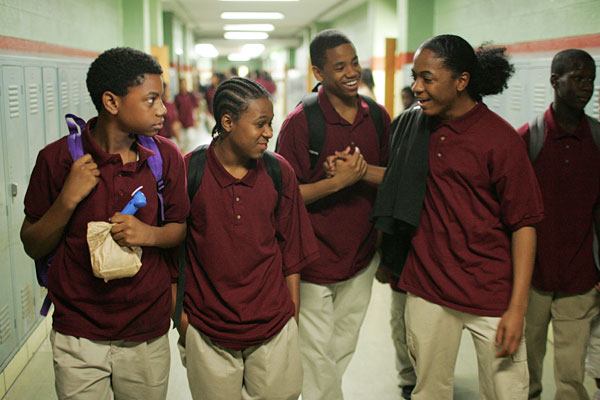
prior to delving into season 4, i quickly read the first in a series of commentaries written by sudhir venkatesh, a sociologist at columbia, as he watched season 5 with "real thugs" - i only skimmed the piece because i did not want to learn too much about the last season before completing the penultimate one. but the ethos of the series - he wrote a commentary after each episode in season 5, viewed alongside men who he had come to know through his research, particularly focused on the underground economy of the drug trade - intrigued me. what would it mean to watch a popular television series depiction of how the systems of education and justice intersect a little too seamlessly in the lives of middle school youth?
i've seen the first episodes in the season, thus far. having invested three seasons in the morality, motivations, and histories of the primary characters, i find myself reading the scenes much differently than if i had started watching with this season. this seems obvious, but also important to note given how often we - the general public - are quick to make judgments - about tv characters, passers-by, acquaintances - without knowing much about them.
and now a confession. there is a scene in the first episode of season 4 where a group of about 6 adolescent boys, who are patiently trying to capture a white dove in order to sell it for a profit, accost a similarly aged boy who has made a noise and scared away the bird. as i watched the boys hurl insults about the single boy's clothing, family life, lack of money, presumed lack of utilities like running water, heat... i had to turn away. my faucet-like tear ducts were in overdrive and i had to pause the dvd momentarily and decide whether i could go on. certainly, this would not be the worst actions depicted in the season, nor in the series thus far. yet, the cruelty of children - regardless of their physical maturation - was the aspect that hurt me (in not entirely unexpected ways) more than others. i suspect this is, in part, due to the fact that i have also witnessed similar discursive moments in my work with young people, and it's the one thing - the words of hurt - that continue to mystify me the most... but also in part because of the possibility and promise that a young face holds.

baldwin's words in "my dungeon shook..." ring loudly in my head. what are the contexts we are all born into, and how do those outside of our contexts read and interpret us based on assumptions about the contexts into which we were born?
in one scene from the third episode, a former police officer experiences his first days as a teacher. he is teaching 8th grade math and struggles to be heard, occasionally receiving the help of one student, randy, who manages to make the situation work for him - grabbing a large stack of hall passes from the teacher's desk on the first day, and quietly exiting the classroom when one girl slices another's face, causing the teacher to panic and freeze, while another, more experienced teacher, walks in and tells one of the students to call 911. the young woman, who caused her classmate to writhe in pain as the floor becomes saturated with her blood, sits scowling against the back wall with her knees clutched up near her chest. the boy who was the object of the verbal insults in episode one - duquan, who is called dukey - slowly approaches her and sits down next to her. he uses a personal fan, which he found on the ground on his walk to school on the first day, to literally cool her off.

there are so many potential opportunities to point fingers in this moment: at the girl who kept taunting her classmate until she snapped; the young woman who called on violence as a means of response; the other students who encourage antagonistic behavior in their peers; the teacher who didn't have enough awareness about what was happening in the class to intercede sooner; new, un-certified teachers, who are placed in large classes with little or no teaching experience because our urban schools are in desperate need of math and science teachers; large class sizes that are not conducive for effective learning (regardless of claims that "the studies don't bear out" effectiveness of small class size)...
with a change in administration, we are sadly seeing what is amounting to "more of the same" as programs like "race to the top" and measures of accountability only serve to reify the primacy of quantifiable, discrete, and isolated skills. the communities of practice we see in the wire are intertwined, interdependent, situated, and contextual; tethered to local and global discourses, and yet like the kids on the screen, youth across the country continue to be reduced to statistics: % of students eligible for free and reduced lunch; # of dropouts and truants; reading grade levels; state assessment percentiles...
who is really benefiting from all of these "changes"?
12.30.2009
images of youth - the year behind, the year ahead
we live in a moment of unparalleled communicative accessibility and information dissemination. youth, so often the object of maligned commentary and political concern, are leading the charge in new modes of expression, purposes for communication, and representations of self. yet, all too often, the stories we see in the popular press about young people are ones that highlight the exceptions and not the norm. that is, we see reported several instances of youth using social networking to plan mass chaos and ultimately inflict harm on others. yes, this does happen and yes we hear about it. but how often do we hear about the use of media and technologies by youth to engage in social action? for inspiring stories, see below:
A positive face of youth in the media - Today's Youth-Led Media Summit brings together enthusiastic young people from around the UK who want to determine their future role – and dispel the image of dangerous hoodies
Youth Radio - Youth Radio was founded in 1990 on the deeply held belief that underserved youth, ages 14-24 years old, have the creativity, technical skills and entrepreneurial spirit to become leaders in the multi-media industry and the community and to serve as mentors to other youth.
new book about harlem, youth, and multimodal literacy - In her new book, Valerie Kinloch investigates how the lives and literacies of youth in New York City’s historic Harlem are affected by public attempts to gentrify the community. Kinloch engages the perspectives of two young men who use documentary and video making to guide their collaborative inquiry.
Adobe Youth Voices/ Listen Up! in India - In November the Listen Up! team traveled to India with our Adobe Youth Voices partners to to work with teachers and students in documentary and animation filmmaking.
America's Youth Speak Out - America's Youth Speak Out is the only youth produced national public service campaign. More than 4000 young people across the country are producing public service messages dealing with issues that are important in their lives and communities.
Youth video conference highlight: The Choose to Be the Change youth video project highlighted the Northern Ontario First Nations Communications Conference
what i hope for in the year to come are what michelle fine has referred to as "audiences that are worthy" - an interpretive context for the words, images, stories, and storying by youth that embraces a generous and generative posture. having worked with youth to produce numerous of varied artifacts in which young people make themselves vulnerable, i am particularly committed to seeking, finding, and creating meaningful audiences for the narrative insights embodied by these artifacts. may 2010 be the year to start/continue this work more effectively...
...
A positive face of youth in the media - Today's Youth-Led Media Summit brings together enthusiastic young people from around the UK who want to determine their future role – and dispel the image of dangerous hoodies
Youth Radio - Youth Radio was founded in 1990 on the deeply held belief that underserved youth, ages 14-24 years old, have the creativity, technical skills and entrepreneurial spirit to become leaders in the multi-media industry and the community and to serve as mentors to other youth.
new book about harlem, youth, and multimodal literacy - In her new book, Valerie Kinloch investigates how the lives and literacies of youth in New York City’s historic Harlem are affected by public attempts to gentrify the community. Kinloch engages the perspectives of two young men who use documentary and video making to guide their collaborative inquiry.
Adobe Youth Voices/ Listen Up! in India - In November the Listen Up! team traveled to India with our Adobe Youth Voices partners to to work with teachers and students in documentary and animation filmmaking.
America's Youth Speak Out - America's Youth Speak Out is the only youth produced national public service campaign. More than 4000 young people across the country are producing public service messages dealing with issues that are important in their lives and communities.
Youth video conference highlight: The Choose to Be the Change youth video project highlighted the Northern Ontario First Nations Communications Conference
what i hope for in the year to come are what michelle fine has referred to as "audiences that are worthy" - an interpretive context for the words, images, stories, and storying by youth that embraces a generous and generative posture. having worked with youth to produce numerous of varied artifacts in which young people make themselves vulnerable, i am particularly committed to seeking, finding, and creating meaningful audiences for the narrative insights embodied by these artifacts. may 2010 be the year to start/continue this work more effectively...
...
12.15.2009
new york: task force on transforming juvenile justice - *now* can we imagine a new way??
The recently published new york times article about youth detention facilities in new york state details a persistent state of "crisis" rampant in these institutions. The article is based on a report written by New York Governor Patterson's Task Force on Transforming Juvenile Justice. Juvenile prisons are described as "both extremely expensive and extraordinarily ineffective" by the report, as cited in the article. The statistics are at once disheartening and familiar: more than half the youth in detention facilities are incarcerated for minor offenses (theft, drug possession, truancy); over 80% are black or Latino; almost all of the new york city, who comprise 76% new york state's juvenile detention population, are housed outside of the city and out of reach of their support networks due to prohibitive costs that might make frequent travel impossible.
While I was pleased to see alternative mentioned twice in the article, which has garnered attention quickly since it was published, the mentions are limited: one about the need for alternatives such as therapeutic foster care and another about an overall recommendation made by Gladys Carrión, the commissioner of the Office of Children and Family Services, "that judges find alternative placements for most young offenders." I have spent eight of the last fourteen years involved with incarceration alternatives as a teacher, tutor, researcher, and volunteer, and in that time have come to appreciate the nuanced possibilities for reimagining futures that alternative to incarceration (ATI) programs can provide. One of these programs is located in new york city and has a rich history of innovative programming to support the post-incarceration lives of youth. As a researcher I have been able to document the varied and situated practices of the staff of this program for the past five years and what is consistent, amidst the diversity of approaches, is the commitment to court-involved evident. Teachers, case managers, counselors, court representatives, administrators (for the most part) share a personal connection to the Justice System and bring with them an empathy and a sense of possibility to their work with the (mostly) young men at the program. Education and employment work in tandem as dual objectives that are addressed by the program's offerings, which include arts and media electives and a college preparatory program. What is readily evident in this space, and what feels quite absent from the austere environs and discourses described in the Task Force Report, is the embodied understanding of what Maxine Greene describes as the "not yet" - at 14, 15, 16 or even as young as 10 and 11, how many of us were already the person we are today, and what are the many ways in which we may continue to change years from now, if those around us will allow it. Greene's response to her own question ("Who am I?"), "I am who I am not yet" is imbued with a deep sense of possibility - a narrative necessary for education; perhaps especially important for young people whose institutional scrapes have amounted to war wounds they wear daily like a heavy mantle.
The new york times article ends with this quote by "Clara Hemphill, a researcher and author of a report on the state’s youth prisons published in October by the Center for New York City Affairs at the New School"
The seeing of youth as animals may not be a perspective confined to detention institutions; judges, police officers, educators, administrators are all adults who have the opportunity to redirect their gaze away from solely individualistic theories of social transgressions at multiple moments of human interaction with youth. Yet too many choose to impose un-nuanced and simplified rationales when understanding socially complex realities. The response to "crime" need not be an unquestioning lockdown mentality. Rather, there is great restorative potential in the city's ATIs and alternative to detention (ATD) programs (aimed at children and adolescents who are charged with an infraction and placed under the care of the Family Courts when they are ages 9-16). Restorative is not merely rehabilitative or remediation; restorative implicates all those engaged in the post-incarceration well-being of an adolescent - family, educators, community: the restoration of a sense of possibility, of a future re-imagined. The ATI with which I have been involved does not dismiss the histories of the young men who walk through its hallways and participate in classrooms, nor does the program find their histories singularly deterministic of their futures. The "alternative" nature of the site lies in the considerations that have been made to address and attend to the manifestations of multiple social systems that converge on the bodies of adolescents: education, employment, health... But perhaps most significant about the possibilities these ATI and ATD programs hold for court-involved youth to rewrite their futures is their potential to disrupt the larger (and often knee-jerk) public discourse about adjudication, incarceration, and tropes of inevitability.
Can we imagine an approach to legal transgressions that can be described as imaginative, collective, and caring? And lest this suggestion call up protestations about the need to punish crimes, let's remember that the majority of the cases for which youth are arrested or sentenced involve offenses that say more about our social systems than any individual proclivity. We certainly don't want persons in positions of power to continue to manipulate the lives of youth for their own personal gain or out of some personal vendetta. Moving through ATI and ATD programs are young people - like Patrick and Eric and Ed and Nicole and Brite and Emanuel and Tiffany and Angel and Christian and many more - who are so much than the arrest code hastily jotted on the standard intake form. They are poets and thinkers and social theorists and artists and writers and brothers and singers and sisters whose complete has "not yet" been written. Can we imagine spaces for young people to not only make their stories known; but also to story themselves differently in the world?
Click here for the complete report by the governor's task force.
While I was pleased to see alternative mentioned twice in the article, which has garnered attention quickly since it was published, the mentions are limited: one about the need for alternatives such as therapeutic foster care and another about an overall recommendation made by Gladys Carrión, the commissioner of the Office of Children and Family Services, "that judges find alternative placements for most young offenders." I have spent eight of the last fourteen years involved with incarceration alternatives as a teacher, tutor, researcher, and volunteer, and in that time have come to appreciate the nuanced possibilities for reimagining futures that alternative to incarceration (ATI) programs can provide. One of these programs is located in new york city and has a rich history of innovative programming to support the post-incarceration lives of youth. As a researcher I have been able to document the varied and situated practices of the staff of this program for the past five years and what is consistent, amidst the diversity of approaches, is the commitment to court-involved evident. Teachers, case managers, counselors, court representatives, administrators (for the most part) share a personal connection to the Justice System and bring with them an empathy and a sense of possibility to their work with the (mostly) young men at the program. Education and employment work in tandem as dual objectives that are addressed by the program's offerings, which include arts and media electives and a college preparatory program. What is readily evident in this space, and what feels quite absent from the austere environs and discourses described in the Task Force Report, is the embodied understanding of what Maxine Greene describes as the "not yet" - at 14, 15, 16 or even as young as 10 and 11, how many of us were already the person we are today, and what are the many ways in which we may continue to change years from now, if those around us will allow it. Greene's response to her own question ("Who am I?"), "I am who I am not yet" is imbued with a deep sense of possibility - a narrative necessary for education; perhaps especially important for young people whose institutional scrapes have amounted to war wounds they wear daily like a heavy mantle.
The new york times article ends with this quote by "Clara Hemphill, a researcher and author of a report on the state’s youth prisons published in October by the Center for New York City Affairs at the New School"
“It really is barbaric,” she added, “the way they treat these kids.”I'm reminded of one young man's story about adolescents being called "animal-escents" at the youth facility where he was incarcerated before being offered a spot at the alternative to incarceration program. This was a term - and presumably an attitude - adopted by many of the correction officers at the facility. The term ("animal-escents") and the implied meanings send a profound message to those same young people about how they are viewed and how they might expect to perceived in the future.
The seeing of youth as animals may not be a perspective confined to detention institutions; judges, police officers, educators, administrators are all adults who have the opportunity to redirect their gaze away from solely individualistic theories of social transgressions at multiple moments of human interaction with youth. Yet too many choose to impose un-nuanced and simplified rationales when understanding socially complex realities. The response to "crime" need not be an unquestioning lockdown mentality. Rather, there is great restorative potential in the city's ATIs and alternative to detention (ATD) programs (aimed at children and adolescents who are charged with an infraction and placed under the care of the Family Courts when they are ages 9-16). Restorative is not merely rehabilitative or remediation; restorative implicates all those engaged in the post-incarceration well-being of an adolescent - family, educators, community: the restoration of a sense of possibility, of a future re-imagined. The ATI with which I have been involved does not dismiss the histories of the young men who walk through its hallways and participate in classrooms, nor does the program find their histories singularly deterministic of their futures. The "alternative" nature of the site lies in the considerations that have been made to address and attend to the manifestations of multiple social systems that converge on the bodies of adolescents: education, employment, health... But perhaps most significant about the possibilities these ATI and ATD programs hold for court-involved youth to rewrite their futures is their potential to disrupt the larger (and often knee-jerk) public discourse about adjudication, incarceration, and tropes of inevitability.
Can we imagine an approach to legal transgressions that can be described as imaginative, collective, and caring? And lest this suggestion call up protestations about the need to punish crimes, let's remember that the majority of the cases for which youth are arrested or sentenced involve offenses that say more about our social systems than any individual proclivity. We certainly don't want persons in positions of power to continue to manipulate the lives of youth for their own personal gain or out of some personal vendetta. Moving through ATI and ATD programs are young people - like Patrick and Eric and Ed and Nicole and Brite and Emanuel and Tiffany and Angel and Christian and many more - who are so much than the arrest code hastily jotted on the standard intake form. They are poets and thinkers and social theorists and artists and writers and brothers and singers and sisters whose complete has "not yet" been written. Can we imagine spaces for young people to not only make their stories known; but also to story themselves differently in the world?
Click here for the complete report by the governor's task force.
12.02.2009
who am i to do this? poetic musings on cross-cultural research
in 2004, i defended my doctoral dissertation. this was both a proud and apprehensive moment for me, as i wrestled with questions of representation - had i done my boys justice? how were they being read and known at the end of this long process? and how would they continue to be known as i made our stories known through my writing in years to come... i'm thinking about deborah appleman's essay titled, "are you making me famous or are you making me a fool?" and in the spirit of ongoing self-reflexivity, i reprint here the opening lines of my dissertation, complete with the opening epigraph:
I am not an African American adolescent boy.
I have not been called a “superpredator,”
Or had prisons built in anticipation of my “delinquency” or on the basis of my third grade
scores on school-based reading assessments.
I am a South Asian American late-twenties woman.
I have been called a “good type of immigrant”
Whose school performance is lauded and whose labor is valued in an increasingly
globalized market economy; though my hue causes labor unrest.
We were a group of five African American boys and a South Asian American woman
Who told stories together
Had fun and played and
Made a place by co-constructing space to talk back, to
Story against and beyond the readily available and overly abundant
Images
These might be stories that no one wants to hear.
Who am I to do this?
-------------
and an image that shows and tells much about our time together, that came to be known in our group as "our picture"

If you have come to help me, you are wasting your
time. But if you have come because your liberation is
bound up with mine, then let us work together.
-Lila Watson
time. But if you have come because your liberation is
bound up with mine, then let us work together.
-Lila Watson
I am not an African American adolescent boy.
I have not been called a “superpredator,”
Or had prisons built in anticipation of my “delinquency” or on the basis of my third grade
scores on school-based reading assessments.
I am a South Asian American late-twenties woman.
I have been called a “good type of immigrant”
Whose school performance is lauded and whose labor is valued in an increasingly
globalized market economy; though my hue causes labor unrest.
We were a group of five African American boys and a South Asian American woman
Who told stories together
Had fun and played and
Made a place by co-constructing space to talk back, to
Story against and beyond the readily available and overly abundant
Images
of black boys in needOurs are stories of ample reflection, hopeful digressions, strong critique, and possibilities.
of remediation,
from deficient literacies;
in a state of corrections.
These might be stories that no one wants to hear.
Who am I to do this?
-------------

11.27.2009
The dangers of starting with and stopping at critique
I'm reading margery wolf's book, "a thrice told tale: feminism, postmodernism, and ethnographic responsibility." Just 14 pages in, one chapter finished, and I can sense my frustration with some of her discursive maneuvers - e.g. Reifying th existence of the other; adherence to "first-world"/"third-world" dichotomizing; pragmatism of ethnographer's authority; difficulty with assuming too reflexivity... It is the same skepticism, I suspect, that a statistician may feel upon reading narrative accounts of
But having been a reader for most of my life - an equally voracious reader of academic texts and those not intended as academic texts (but of course that is quite a blurry line...) - I know to keep my skepticism and discomfort at bay, so that I don't stop reading or, worse, make judgments and assumptions on text I have not consumed or interpreted. This is a danger that plagues not only some of the youth with whom I spend time - "Ugh. This is stupid! The author doesn't know what he's talking about." - but some of the graduate students who opt to take the classes I teach - "This research is offensive and clearly perpetuating negative stereotypes." When we are stuck in the paralysis of critique, it becomes difficult to find a way out. I have erroneously suggested a close re-reading, but as I am newly aware of my own paralytic tendencies, I realize that such a close (re)reading can only be effective if one's reading posture - metaphorical, but perhaps also literal, e.g. from hunched over a table to relaxing on the couch - retains a sense of possibility.
What is the author trying to say? What other texts and discourses are present in the authors' words and assumptions? How is the author using evidence, narrative structure, and language to convey an argument? What do you have to believe in order to take the author at her word?
We lose, it seems to me, our appreciation for the ontological underpinnings for the texts we engage daily. We are poised to agree and disagree. To critique and put down. To point out flaws and shortcomings. We are woefully underprepared - or perhaps unwilling - to consider the possibility of other realities, and to meaningfully engage with others' texts. Such "paralysis by critique" is evident in the overzealous student eager to participate in what s/he assumes is the only tradition of academic discourse; a subway rider expressing disdain for a young man's practice of quietly singing along with his mp3 player; a poltical pundit unable to cede the floor for anyone else's opinion to be heard; and on and on.
Maybe we all just need to learn how to read and appreciate reading (again). Although for some it may be the first time, especially as new reading curricula are stripped of appreciation - a recent casualty being, of course, the beloved "Reading Rainbow"...
11.26.2009
plurality of pedagogical postures
just as we have come to understand the plurality of literacies, i've begun to appreciate the nuanced and multiple nature of teachings and learnings. in the beginning pages of teaching as a performing art, seymour sarason likens the practice of teaching to the experiences of dramatic performance. he cites the incessant, no matter how miniscule, stage fright he feels when he enters 'the classroom' and the consequences of losing one's audience... i wonder if these principles hold true across pedagogical philosophies. david hansen, in the call to teach, describes the pedagogical identity of one of the teachers he profiles in this way,
these questions, about our multiple pedagogical postures, swirl in my head as i think about the role of play in my own pedagogy. there is an implicit disdain with which play is regarded outside of the elementary school classroom... laughter and humor, in measured amounts, are respectable, but the introduction of silliness, the absurd, or something too carnivalesque or "extravagant" (see boon - Verging on extra-Vagance) garners great skepticism.
lately i have felt beleaguered by a sense that my educational practice, in which i assume and inhabit the performances of a teacher as informed by the formal parameters of particular settings, has become hostage to my own hesitations about my moral purpose. education is a site of possibility as well as conflict, and often both. yet conflict resonates loudly, leaves residue on our psyches, and, if not effectively engaged, can be a poorly placed anchor in swift tides. in the past, i've assumed/embraced/embodied a pedagogy of play, and implicit in such a way of being is a stance of with. that is, a collaborative spirit with which to conceive of, understand, and take on an endeavor. that stance, and its connected ways of knowing, has been challenged in interesting ways in recent months, leading me to more fully understand the role of community in how we come to know, and how we come to educate and be educated. community in the form of kindred spirits, hearty debaters, and longtime allies, all of whom share in the spirit of education and inquiry that is both purposeful and also unpredictable; where interactions, however brief, are not merely sound bytes, but meaningful spaces of intellectual work and making known; and where intentionality is implicitly understood, and not critiqued within an inch of its life. community is both conflict and possibility, inquiry and knowing; a kind of home we create to sustain our sense of self, of belonging, of purpose.
...
"[Mr. James] conducts himself as a moral agent--as a person, that is, who can have a positive influence on students--and as a moral educator--a person whose pedagogical obligation is to steer students toward the Good." (p. 68)do we assume the same pedagogical posture, i wonder, across the multiple settings in which we teach and are taught? and how might we retain our moral purpose - not to be confused with the rhetoric of morality and moral education that seeks to privilege certain values over others and is manifested in the guise of 'character education' or some 'civic education' curricula - to be, as hansen describes, a "moral educator" and engage in education with others? (i, too, wonder about the Good - whose Good? how determined? and does the meaning of Good shift?...) if, like herve varenne and colleagues (see tc record, volume 109, july 2007) we recognize that "Education is fundamental to sociability and is ubiquitous in the everyday life of all human beings" (p. 1561), then how do we attend to the many moments of education in which we engage in daily and deliberately? and how do teaching and education come together? and how might we decouple learning from education? education from schooling? so that the practice of education is not reduced to discrete and simple transactions of information as freire feared when he argued against a "banking model of education?"
these questions, about our multiple pedagogical postures, swirl in my head as i think about the role of play in my own pedagogy. there is an implicit disdain with which play is regarded outside of the elementary school classroom... laughter and humor, in measured amounts, are respectable, but the introduction of silliness, the absurd, or something too carnivalesque or "extravagant" (see boon - Verging on extra-Vagance) garners great skepticism.
lately i have felt beleaguered by a sense that my educational practice, in which i assume and inhabit the performances of a teacher as informed by the formal parameters of particular settings, has become hostage to my own hesitations about my moral purpose. education is a site of possibility as well as conflict, and often both. yet conflict resonates loudly, leaves residue on our psyches, and, if not effectively engaged, can be a poorly placed anchor in swift tides. in the past, i've assumed/embraced/embodied a pedagogy of play, and implicit in such a way of being is a stance of with. that is, a collaborative spirit with which to conceive of, understand, and take on an endeavor. that stance, and its connected ways of knowing, has been challenged in interesting ways in recent months, leading me to more fully understand the role of community in how we come to know, and how we come to educate and be educated. community in the form of kindred spirits, hearty debaters, and longtime allies, all of whom share in the spirit of education and inquiry that is both purposeful and also unpredictable; where interactions, however brief, are not merely sound bytes, but meaningful spaces of intellectual work and making known; and where intentionality is implicitly understood, and not critiqued within an inch of its life. community is both conflict and possibility, inquiry and knowing; a kind of home we create to sustain our sense of self, of belonging, of purpose.
...
Multimodality and Learning Conference - updated info
Multimodality and Learning Conference: Environments, Rhetoric, Recognition, Play, and Methods
July 6th and 7th 2010
Institute of Education, London
Conference information
Aim and scope
The overall aim of the conference is to explore multimodal perspectives on learning and to open up theoretical, methodological and pedagogical questions and debate.The conference will be of interest to educational practitioners, research students,researchers and academics from a variety of disciplines including semiotics, linguistics, sociology, anthropology and design.
Call for papers (symposiums)
Individual call for papers
Thematic strands
July 6th and 7th 2010
Institute of Education, London
Conference information
Aim and scope
The overall aim of the conference is to explore multimodal perspectives on learning and to open up theoretical, methodological and pedagogical questions and debate.The conference will be of interest to educational practitioners, research students,researchers and academics from a variety of disciplines including semiotics, linguistics, sociology, anthropology and design.
Call for papers (symposiums)
Individual call for papers
Thematic strands
- Environments of learning: institutional, work based, and beyond
School, home, work places, museums, digital environments
Keynote: Dr Jonathan Hindmarsh, Kings College, London, UK - Rhetoric and the politics of representation and communication
Narrative, persuasion, genre, argument, information design
Keynote: Professor Lilie Chouliaraki, London School of Economics, UK
- Recognition, evaluation, assessment
Discourses of accountability, criteria for evaluation, power, processes of assessment
Keynote: Professor Gunther Kress, Institute of Education, University of
London, UK
- Play: games, experience, and learning
Oral traditions, ludic modes, cultures of play, play and creativity
Keynote: Professor Suzanne de Castells, Simon Fraser University, Vancover,
Canda and Dr Jennifer Jensen, York University, Toronto, Canada
- Methodologies
Multimodal data collection, transcription, analysis, multimodal dissemination
Keynote: Dr Jennifer Rowsell, Rutgers University, New Jersey, USA and Dr
Kate Pahl, Sheffield University, UK
11.13.2009
pedagogy that is culturally relevant
how do we move towards knowing in our everyday pedagogies? what spaces to we find where we can play, free from institutional constraints? in whose eyes do we see possibilities and to whose do we relegate despair? how do maintain our sense of pedagogical pleasure(s) amidst perceived institutional constraints? what might it mean to commune as teachers who are students of our students? to spend time with youth outside the constraints of institutional labels, expectations, assumptions; and to descriptively observe their literacies in action? what are the ways in which we relate to one another? how do we decide to look up or turn away? when do we extend a hand or hasten our pace? to whom do we accord great variation in the performance of multiple selves? and from whom do we expect staid and limited representations of self? with whose purposes do embark on the journey of education? how, amidst the unsettling and unsettled, do we create a sense of home, of belonging together? and allow space for multiple, even disparate forms of belonging within a common site/moment/act of education?
11.03.2009
new book about harlem, youth, and multimodal literacy

by Valerie Kinloch
Teachers College Press, 2009
Discourses of youth, gentrification, place, space, and literacies converge beautifully in this volume, collaboratively constructed by Valerie Kinloch and youth researchers, who explored changes going on in Harlem through a variety of modes, discursive interactions, and ongoing inquiry.
Definitely explore and purchase for your own reading, or to read with youth, undergraduate and graduate students interested the complicated intersections of identity, place, power, and narrative discussed in this book.
From the publisher:
In her new book, Valerie Kinloch investigates how the lives and literacies of youth in New York City’s historic Harlem are affected by public attempts to gentrify the community. Kinloch draws connections between race, place, and students’ literate identity through collaborative interviews between youth, teachers, longtime black residents, and their new white neighbors. Harlem on Our Minds is a participatory action narrative that makes emerging theories of social ecology real for the high-school English classroom. Vividly drawn lessons show how teachers can engage urban youth in school-based literacy, by linking canonical text, particularly of the Harlem renaissance, to current events. Centered on the literacy stories of two African American youth and their peers, this book for our times:
- Showcases the multimodal literacy practices of urban youth through photos, writing samples, student-designed research projects, and more.
- Weaves in multiple voices and perspectives through response pieces by project participants, local teachers, graduate students, and a community activist.
- Features teaching strategies and reflection points in each chapter.
10.30.2009
multimodality and learning conference 2010 - call for papers
Multimodality and Learning Conference: Environments, Rhetoric, Recognition, Play, and Methods
July 6th and 7th 2010Institute of Education, Bloomsbury, London, UK
Aim and scope
The overall aim of the conference is to explore multimodal perspectives on learning and to open up theoretical, methodological and pedagogical questions and debate. The conference will be of interest to educational practitioners, research students, researchers and academics from a variety of disciplines including semiotics, linguistics, sociology, anthropology and design.
Call for papers
We welcome symposia and individual papers on multimodality and learning that address the conference themes outlined in the attachment: Thematic strands. Abstracts can be submitted using the forms available at: www.multimodality.org.uk. Further information on submitting an abstract will be posted on the website shortly.
All abstracts will be peer-reviewed. Deadline 5pm on 26th February 2010.
Registration
Conference fee: £200 full fee; Students £100. Lunch and light refreshments included, acommodation not included. Registration deadline 31 May 2010
Key dates
26th February 2010 Deadline for submission of abstracts 31st May 2010 Deadline for registration 6th and 7th July 2010
Conference Organizing committee: Centre for Multimodal Research, Institute of Education, University of London – Richard Andrews, Jeff Bezemer, Andrew Burn, Sophia Diamantopoulou, Carey Jewitt, Gunther Kress, Diane Mavers, Caroline Pelletier
10.25.2009
digital media and learning conference - call for papers, deadline: 10.30.2009
DML: First Annual Digital Media and Learning Conference
Conference Theme: "Diversifying Participation"
Call for papers - Deadline: October 30, 2009
Conference Committee: Henry Jenkins, David Theo Goldberg, Heather Horst, Mimi Ito, Jabari Mahiri and Holly Willis
Keynote speakers: Sonia Livingstone and S. Craig Watkins
(from the call)
DIVERSIFYING PARTICIPATION
A growing body of research has identified how young people's digital media use is tied to basic social and cultural competencies needed for full participation in contemporary society. We continue to develop an understanding of the impact of these experiences on learning, civic engagement, professional development, and ethical comprehension of the digital world.
Yet research has also suggested that young people's forms of participation with new media are incredibly diverse, and that risks, opportunities, and competencies are spread unevenly across the social and cultural landscape. Young people have differential access to online experiences, practices, and tools and this has a consequence in their developing sense of their own identities and their place in the world. In some cases, different forms of participation and access correspond with familiar cultural and social divides. In other cases, however, new media have introduced novel and unexpected kinds of social differences, subcultures, and identities.
It is far too simple to talk about this in terms of binaries such as "information haves and have nots" or "digital divides". There are many different kinds of obstacles to full participation, many different degrees of access to information, technologies, and online communities, and many different ways of processing those experiences. Participatory cultures surrounding digital media are characterized by a diversity that does not track automatically to high and low access or more or less sophisticated use. Rather, multiple forms of expertise, connoisseurship, identity, and practice are proliferating in online worlds, with complicated relationships to pre-existing categories such as socioeconomic status, gender, nationality, race, or ethnicity.
We encourage sessions that describe, document, and critically analyze different forms of participation and how they relate to various forms of social and cultural capital. We are interested in accounts of the challenges and obstacles which block or inhibit engagement to different forms of online participation. We also encourage session proposals that engage with successful intervention strategies and pedagogical processes enabling once marginalized groups to more fully exploit the opportunities for learning with digital media. Conversely, we are interested in hearing more about how marginal and subcultural communities find diverse uses of new and emerging technologies, pushing them in new directions and navigating a complicated relationship with "mainstream" forms of participation. Specifically, we seek to understand the following:
Read more on conference website.
.
Conference Theme: "Diversifying Participation"
Call for papers - Deadline: October 30, 2009
Conference Committee: Henry Jenkins, David Theo Goldberg, Heather Horst, Mimi Ito, Jabari Mahiri and Holly Willis
Keynote speakers: Sonia Livingstone and S. Craig Watkins
(from the call)
DIVERSIFYING PARTICIPATION
A growing body of research has identified how young people's digital media use is tied to basic social and cultural competencies needed for full participation in contemporary society. We continue to develop an understanding of the impact of these experiences on learning, civic engagement, professional development, and ethical comprehension of the digital world.
Yet research has also suggested that young people's forms of participation with new media are incredibly diverse, and that risks, opportunities, and competencies are spread unevenly across the social and cultural landscape. Young people have differential access to online experiences, practices, and tools and this has a consequence in their developing sense of their own identities and their place in the world. In some cases, different forms of participation and access correspond with familiar cultural and social divides. In other cases, however, new media have introduced novel and unexpected kinds of social differences, subcultures, and identities.
It is far too simple to talk about this in terms of binaries such as "information haves and have nots" or "digital divides". There are many different kinds of obstacles to full participation, many different degrees of access to information, technologies, and online communities, and many different ways of processing those experiences. Participatory cultures surrounding digital media are characterized by a diversity that does not track automatically to high and low access or more or less sophisticated use. Rather, multiple forms of expertise, connoisseurship, identity, and practice are proliferating in online worlds, with complicated relationships to pre-existing categories such as socioeconomic status, gender, nationality, race, or ethnicity.
We encourage sessions that describe, document, and critically analyze different forms of participation and how they relate to various forms of social and cultural capital. We are interested in accounts of the challenges and obstacles which block or inhibit engagement to different forms of online participation. We also encourage session proposals that engage with successful intervention strategies and pedagogical processes enabling once marginalized groups to more fully exploit the opportunities for learning with digital media. Conversely, we are interested in hearing more about how marginal and subcultural communities find diverse uses of new and emerging technologies, pushing them in new directions and navigating a complicated relationship with "mainstream" forms of participation. Specifically, we seek to understand the following:
- What can research on more diverse communities contribute to our understanding of the learning ecologies surrounding new media?
- What are the technologies, practices, economic, and cultural divides that lead to segregation, "gated" information communities, and differential access?
- When and how do diversity and differentiation in participation promote social and cultural benefits and opportunities, and when do they create schisms that are less equitable or productive?
- What strategies have proven successful at broadening opportunities for participation, overcoming the many different kinds of segregation or exclusion which impact the online world, and empowering more diverse presences throughout cyberspace?
- Are there things occurring on the margins of the existing digital culture that might valuably be incorporated into more mainstream practices?
Read more on conference website.
.
Subscribe to:
Posts (Atom)